
What is the Billings Ovulation Method?
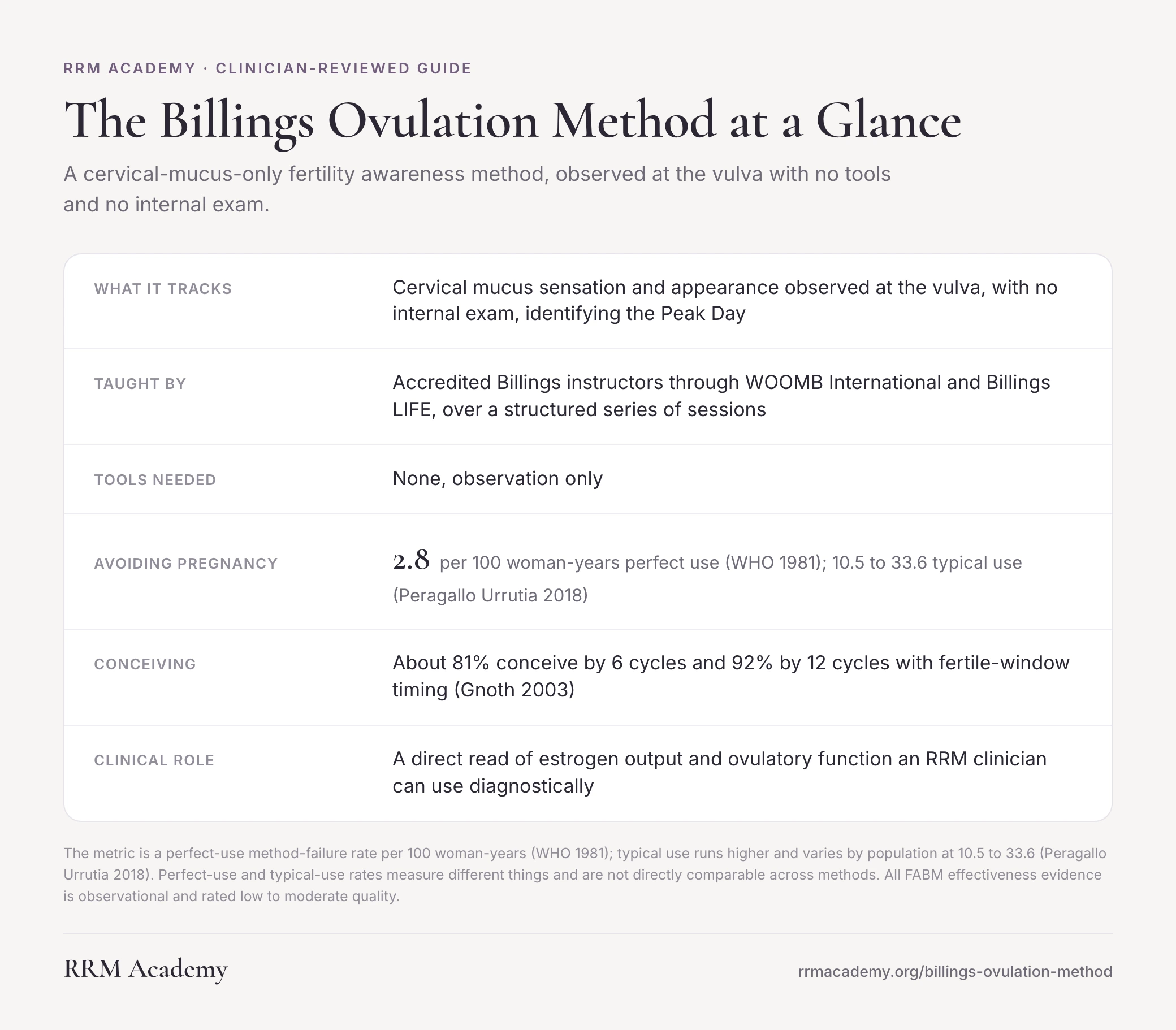
The Billings Ovulation Method needs no tools. No thermometer, no device, no application, no internal examination. A woman observes the sensation and appearance of cervical mucus at the vulva each day, records what she notices, and reads the pattern the observations produce over time. That pattern tells the story of her ovulatory cycle.
The Billings Ovulation Method is a single-biomarker fertility awareness-based method (FABM) that uses only cervical mucus to identify fertile and infertile phases of the cycle. It was developed by Drs. John and Evelyn Billings in Australia in the 1950s and 1960s and is now taught by accredited instructors affiliated with WOOMB International (World Organisation of the Ovulation Method Billings) and its regional bodies, including Billings LIFE.
The method is entirely non-invasive. Observation takes place at the vulva during ordinary daily activities. There is no internal examination. The woman notes the sensation she feels at the vulva and, where present, the visible qualities of any mucus: its appearance, consistency, and stretch. She records those observations daily using a simple charting system. Over time the chart reveals the wave-like pattern of the ovulatory cycle, from the dry or unchanged days of the early cycle, through the build-up of fertile mucus toward ovulation, to the return of the dry post-Peak phase.
Billings and the Creighton Model FertilityCare System are both mucus-only methods that use vulvar observation, but they are separate methods with different observation frameworks, different charting conventions, and different organizational lineages. For a side-by-side comparison of Billings and other FABMs, see the Fertility Awareness Methods Compared guide.
How does the Billings Ovulation Method work?
Cervical mucus is a direct biological output of the ovulatory cycle. Rising estrogen in the days approaching ovulation drives the cervix to produce mucus that increases in quantity, becomes clearer and more stretchy, and creates a characteristic slippery or lubricative sensation. That sensation, and the appearance of the mucus itself, are what a woman observes and records.
The last day of the most fertile-type mucus in a pattern, identified retrospectively once the dry post-Peak phase has clearly begun, is called the Peak Day. It correlates with the LH surge and the ovulatory event. The days surrounding Peak Day, typically the days of most fertile mucus and Peak Day itself, constitute the fertile window.
After Peak Day, progesterone from the corpus luteum suppresses mucus production, producing the dry post-Peak phase. The length and character of that phase carry information about the luteal phase of the cycle. A trained RRM clinician reading the chart can see that information directly.
Because Billings reads actual mucus biology rather than estimating from calendar averages, cycle regularity is not a prerequisite. Long cycles, irregular cycles, cycles during the post-pill transition, and postpartum cycles all produce the same underlying mucus signal. The chart follows the signal wherever it leads.
How is the Billings Ovulation Method taught?
The Billings Ovulation Method is designed to be taught, not self-administered. Instruction from an accredited Billings teacher is central to how the method functions and directly influences how reliably it works in practice. The international body for Billings instruction is WOOMB International (World Organisation of the Ovulation Method Billings). Billings LIFE (Billings Life, Intercourse, and Fertility Education) is a major teaching network operating in numerous countries.
An accredited Billings instructor teaches the method through a structured series of sessions. At each follow-up, the instructor reviews the chart, helps the woman or couple interpret what the observations mean, and adjusts guidance as the chart evolves. That case-by-case review is how the method adapts to cycle variability, post-pill patterns, postpartum changes, and irregular cycles.
Self-teaching from a book or application is not the protocol Billings is designed around. Instruction quality is a meaningful factor in real-world outcomes.
How effective is the Billings Ovulation Method?
Effectiveness figures for Billings must be read with two categories kept clearly separate: perfect use and typical use. They answer different questions.
Perfect use (method effectiveness). The WHO 1981 five-centre multicentre trial found a method-failure rate of approximately 2.8 pregnancies per 100 woman-years when the method's rules were followed exactly (WHO 1981). This figure answers how reliable the biological signal is when couples apply the rules correctly and consistently. It does not reflect what an average user experiences.
Typical use (real-world effectiveness). Typical-use rates vary considerably across populations and study contexts. A 2018 systematic review of fertility awareness-based methods found typical-use rates for ovulation methods ranging from 10.5 to 33.6 pregnancies per 100 woman-years (Peragallo Urrutia 2018). That range reflects real variation in how consistently different populations apply the method, not inconsistency in the underlying biology.
Evidence quality. All FABM effectiveness data, including Billings, is observational. No randomized controlled trial exists. The same 2018 systematic review found zero high-quality studies across the entire FABM field (Peragallo Urrutia 2018). That is a genuine limitation. It is also a limitation that applies equally to the typical-use rates for the pill and condoms, which come from the same cohort and life-table designs. The standard that applies to Billings applies identically to its comparators.
What is the Billings Ovulation Method used for?
The Billings Ovulation Method serves two related purposes: avoiding pregnancy and supporting conception.
Avoiding pregnancy. The couple identifies the fertile window from the daily mucus observations and avoids genital contact during that window. How consistently they do so is the primary driver of real-world outcomes. The method does not estimate fertile days from calendar averages; it identifies the actual fertile window as the cycle unfolds.
Supporting conception. For couples trying to conceive, the same chart identifies the highest-fertility days. Timing intercourse to the peak fertile days, rather than guessing from a calendar, produces meaningful results. With fertile-window timing, couples in a German sympto-thermal cohort (346 women charting mucus plus temperature) reached cumulative pregnancy rates of about 81% by 6 cycles and 92% by 12 cycles (Gnoth 2003). For couples with underlying cycle abnormalities, identifying the fertile window is the beginning of the picture, not the whole of it.
For a wider comparison of Billings and other fertility awareness methods, see the Fertility Awareness Methods Compared guide.
How the Billings Ovulation Method supports restorative reproductive medicine
In restorative reproductive medicine, the Billings chart is more than a family-planning record. It is a window on estrogen output and ovulatory function that a trained RRM clinician can read diagnostically.
Cervical mucus production is driven by estrogen. The quantity, quality, and timing of the mucus pattern across a cycle reflect how estrogen is rising and falling in relation to the ovulatory event. A chart that shows a short, sparse mucus build-up, an absent or ambiguous Peak, or an unusual post-Peak pattern carries information about what the cycle is actually doing. That information is often invisible in a single-point lab draw or a calendar-estimated hormone panel.
RRM clinicians working with cycle charts, whether Billings or another FABM, can time laboratory evaluation to the biological cycle rather than to a calendar assumption. That distinction matters for characterizing hormone levels accurately. It also matters for identifying cycle irregularities that explain what couples are experiencing but that standard workups, performed without chart context, miss entirely.
This is the core principle RRM brings to the Billings chart: the mucus pattern is a signal worth reading, not a variable to eliminate. Practicing reproductive medicine without that signal means flying blind. For the full framework of how RRM uses cycle charting in clinical evaluation, see the NaProTechnology guide.
How to learn the Billings Ovulation Method
The recognized pathway for learning the Billings Ovulation Method is instruction from an accredited Billings teacher. The two primary international organizations that train and accredit Billings instructors are:
- WOOMB International (World Organisation of the Ovulation Method Billings): woomb.org
- Billings LIFE: billingslife.org
Both organizations maintain directories of accredited instructors and can help a woman or couple find a teacher in their area or via remote instruction.
If the goal extends beyond family planning to understanding why the cycle looks the way it does, or to addressing difficulty conceiving, the chart is also the starting point for a restorative reproductive medicine evaluation. An RRM clinician reads the mucus pattern as a clinical record, not merely a planning tool. The chart is the first step.
To find a clinician who integrates fertility awareness charting with restorative reproductive medicine, visit rrmacademy.org/providers/.
Continue exploring
References
- World Health Organization. A prospective multicentre trial of the ovulation method of natural family planning: II. The effectiveness phase. Fertility and Sterility. 1981;36(5):591-598. PMID 7308503.
- Peragallo Urrutia R, et al. Effectiveness of fertility awareness-based methods for pregnancy prevention: a systematic review. Obstetrics and Gynecology. 2018;132(3):591-604. PMID 30095777.
- Gnoth C, et al. Time to pregnancy: results of the German prospective study. Human Reproduction. 2003;18(9):1959-1966. PMID 12923157.
Frequently Asked Questions
How effective is the Billings Ovulation Method for avoiding pregnancy?
Effectiveness depends heavily on which number is being cited and what it measures. When the method's rules are followed exactly, the WHO 1981 multicentre trial found a method-failure rate of approximately 2.8 pregnancies per 100 woman-years. That is the perfect-use figure: it reflects the reliability of the biological signal when couples apply the rules consistently. WHO 1981
Real-world typical-use rates are higher, ranging from 10.5 to 33.6 pregnancies per 100 woman-years across different populations and study contexts. The range reflects how consistently couples apply the method, not inconsistency in the underlying biology. Peragallo Urrutia 2018
Consult an RRM clinician for guidance specific to your situation.
Do I need a teacher, or can I learn Billings on my own?
The Billings Ovulation Method is designed to be taught. While the daily observations are simple in principle, interpreting the chart accurately across different cycle phases, irregular patterns, post-pill transitions, and postpartum cycles requires guided practice and chart review from an accredited instructor.
WOOMB International and Billings LIFE both maintain directories of accredited teachers. Many instructors now offer remote instruction as well as in-person sessions. Instruction quality is a meaningful factor in how reliably the method works in practice. Self-teaching from a book or application is not the protocol the method was built around.
Consult an RRM clinician for guidance specific to your situation.
Can the Billings Method help us conceive, not just avoid pregnancy?
In many cases, yes. Identifying the fertile window precisely, rather than estimating it from a calendar, allows couples to time intercourse to the days of highest fertility. With fertile-window timing, couples in a German sympto-thermal cohort (346 women charting mucus plus temperature) reached cumulative pregnancy rates of about 81% by 6 cycles and 92% by 12 cycles. Gnoth 2003
For couples who have been trying without success, the chart also provides information an RRM clinician can read diagnostically. Patterns in the mucus build-up, Peak Day timing, and the post-Peak phase can point toward cycle abnormalities worth investigating. The chart is a starting point for that evaluation, not a substitute for it.
Consult an RRM clinician for guidance specific to your situation.
What makes Billings different from the Creighton Model or other mucus methods?
Billings and the Creighton Model FertilityCare System (CrMS) share the same core biomarker: cervical mucus observed at the vulva. Both are mucus-only methods with no thermometer or hormone monitor. The differences lie in the observation framework, charting conventions, terminology, and organizational lineage. Billings comes from the WOOMB tradition; CrMS was developed by Dr. Thomas W. Hilgers at Creighton University and is taught through the Saint Paul VI Institute. They are separate methods with separate instructor certification systems.
CrMS was designed from the outset as the clinical record for NaProTechnology. Billings, while fully readable by an RRM clinician familiar with it, is not the same charting system. For a full side-by-side, see the Fertility Awareness Methods Compared guide.
Consult an RRM clinician for guidance specific to your situation.
Can I use Billings if my cycles are irregular?
In many cases, yes. The Billings Method reads the actual mucus signal rather than assuming a fixed cycle length. Long cycles, variable cycles, and cycles that do not follow a predictable pattern all produce the same underlying mucus biology. The chart follows the signal wherever the cycle goes, rather than imposing a calendar template over it.
Irregular cycles often mean more variability in chart interpretation, which makes regular follow-up with an accredited instructor more important, not less. A teacher who has worked with irregular cycle patterns is well placed to help interpret what the chart is showing. If the irregularity itself is clinically significant, the chart may also provide useful information for an RRM evaluation.
Consult an RRM clinician for guidance specific to your situation.
How does a Billings chart help an RRM clinician?
Cervical mucus production is driven by estrogen. The quantity, quality, and timing of the mucus build-up across the cycle reflect estrogen activity and the ovulatory event in real time. An RRM clinician reading a Billings chart sees a longitudinal record of how the cycle is functioning: whether the build-up toward Peak is robust or sparse, whether Peak Day timing is consistent, and what the post-Peak phase looks like.
That information allows laboratory evaluation to be timed to the biological cycle rather than to a calendar estimate. It also surfaces cycle patterns that standard workups, performed without chart context, often miss. Many couples labeled with unexplained difficulty conceiving have diagnosable cycle abnormalities that the chart makes visible. The chart is not a substitute for clinical evaluation; it is the input that makes the evaluation accurate.
Consult an RRM clinician for guidance specific to your situation.
This content is for educational and reference purposes only and does not constitute medical advice, diagnosis, or treatment. Consult a qualified clinician about your specific situation.