
What is Boston Cross-Check?
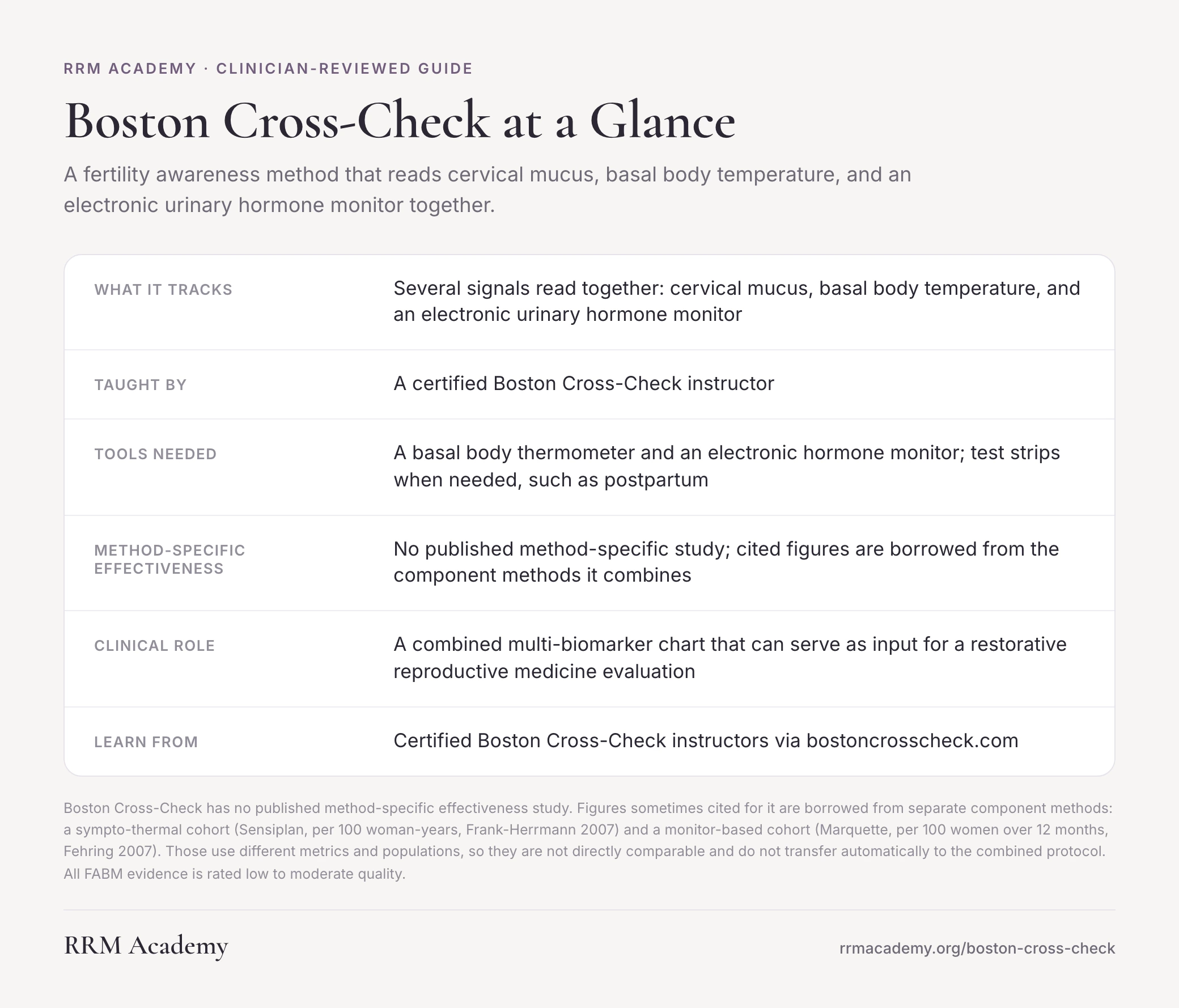
Boston Cross-Check is a fertility awareness-based method that reads several biomarkers together rather than relying on a single signal. Each charting day, the user observes cervical mucus, records a basal body temperature, and reads an electronic urinary hormone monitor. In certain situations, such as the postpartum period, test strips are added to the protocol. The result is a combined daily record that shows the fertile window from multiple angles at once.
No other widely used FABM combines all three of these inputs as its standard approach. The method takes its name from the cross-checking structure: each biomarker can confirm or raise a question about what the others are showing, and the user reads the full picture rather than acting on any single signal in isolation.
To understand how Boston Cross-Check sits within the broader landscape of fertility awareness-based methods, see the FABM comparison guide.
How does Boston Cross-Check work?
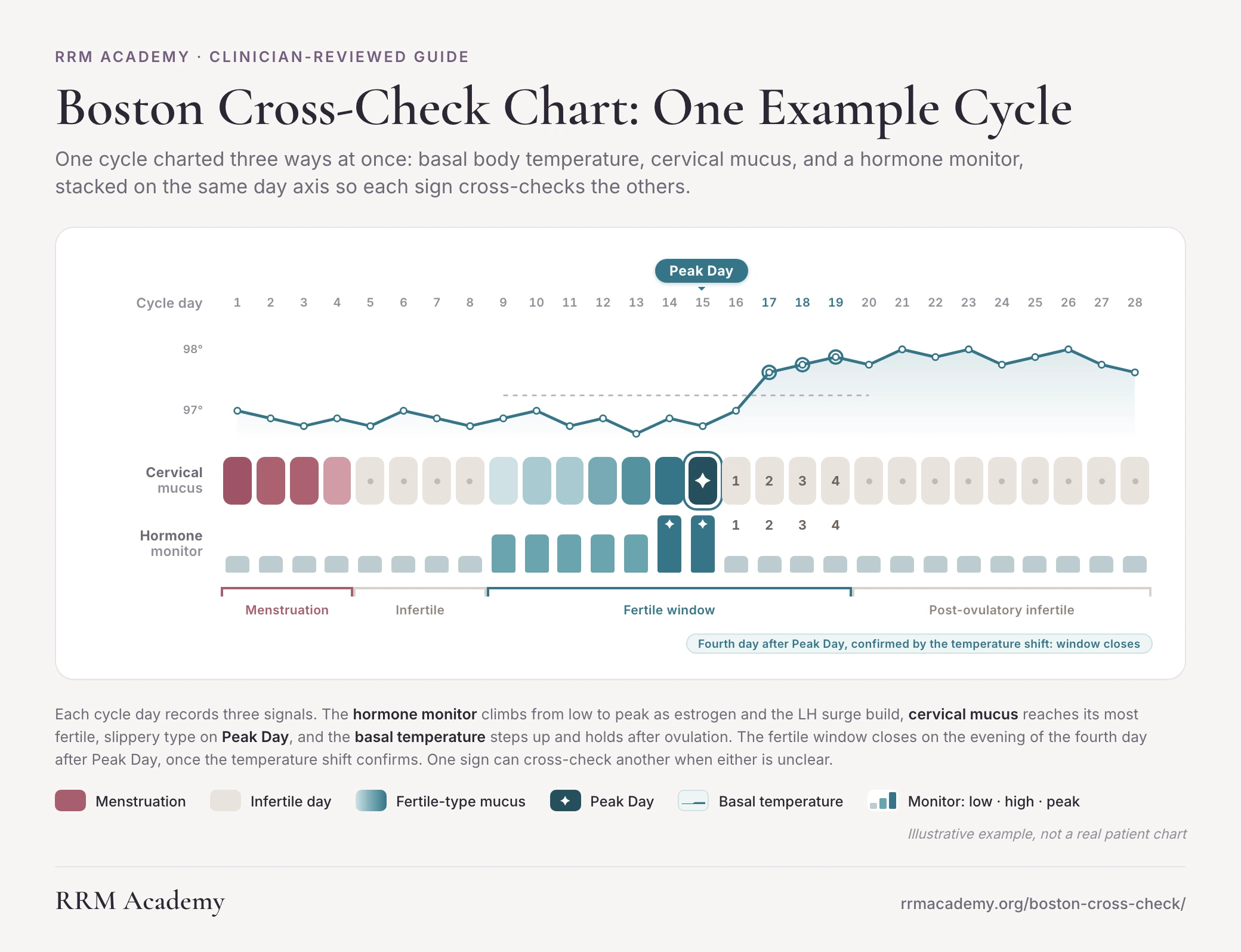
On each day of the cycle, the user makes three observations. Cervical mucus is observed and recorded using the method's charting vocabulary, noting sensation and visible characteristics. Basal body temperature is taken first thing in the morning, before rising, and entered on the chart. The electronic hormone monitor reads urinary LH and estrogen from a test stick, displaying a low, high, or peak reading that tracks where the cycle stands in relation to the ovulatory event.
Together, these three streams of data converge on the same underlying biology. Rising estrogen drives mucus production toward the fertile window and triggers the monitor's high reading. The LH surge, which precedes ovulation by roughly 24 to 36 hours, produces the monitor's peak reading and correlates with the transition through Peak Day on the mucus chart. The temperature rise, caused by progesterone from the corpus luteum, confirms that the ovulatory event has occurred and that the post-Peak phase of the cycle has begun.
Reading these signals together can make the fertile window easier to identify, particularly in cycles where one biomarker is ambiguous. A temperature that is slow to rise is easier to interpret when the mucus pattern and monitor reading are also visible. A mucus observation that is uncertain can be cross-checked against what the monitor showed that day. The method does not eliminate the need for careful daily observation, but it gives the user more information to work with at each decision point.
In certain situations, such as the postpartum period, test strips are added to supplement what the monitor reads, because the hormonal environment after birth can require additional input to chart accurately.
How is Boston Cross-Check taught?
Boston Cross-Check is taught by certified Boston Cross-Check instructors. As with other instructor-led fertility awareness methods, the recognized learning pathway is structured instruction from a qualified teacher, not self-teaching from a book or app.
Instruction quality matters for any multi-biomarker method. When a user is learning to read three simultaneous signals, an instructor who can review the chart, identify where observations were unclear, and help the user understand what the combined record is showing plays a central role in building charting accuracy. The instructor also guides the user through situations where the biomarkers diverge and a decision rule is needed.
To learn Boston Cross-Check, visit bostoncrosscheck.com to find a certified instructor.
How effective is Boston Cross-Check?
Boston Cross-Check has no published method-specific effectiveness study. The method has not been evaluated as its own protocol in a peer-reviewed cohort. Any effectiveness rate cited for it is borrowed from the separate methods whose biomarkers it combines.
For the sympto-thermal component (temperature combined with mucus), the most rigorous published data come from a large prospective European cohort studying Sensiplan. In that cohort of 900 women contributing 17,638 cycles, the perfect-use (method-related) failure rate was 0.4 per 100 women over 13 cycles and the typical-use failure rate was 1.8 per 100 women over 13 cycles (Frank-Herrmann P et al. 2007).
For the monitor-based component, the closest published data come from a Marquette Method study examining urinary hormone monitor use. In that cohort, the method-use failure rate was 2.1 per 100 women over 12 months and the use-related failure rate was 14.2 per 100 women over 12 months (Fehring RJ et al. 2007).
Whether combining biomarkers improves or complicates real-world outcomes compared to using each individually has not been studied for this method. Instruction from a certified Boston Cross-Check instructor, consistent daily observation, and careful chart reading remain the foundations of effective use regardless of what the component-method literature reports.
What is Boston Cross-Check used for?
Boston Cross-Check serves two connected purposes.
Couples who want to avoid pregnancy use the combined chart to identify the fertile window and time genital contact accordingly. The multi-biomarker record gives several independent signals to work from when making that daily determination. Couples trying to conceive use the same chart to identify the days of highest fertility, targeting intercourse toward the mucus peak, the monitor's peak reading, and the days immediately before the temperature rise.
The combined record can also serve as the clinical input for a restorative reproductive medicine evaluation. An RRM clinician reading a chart that includes mucus, temperature, and hormone monitor data has a richer clinical picture than a chart built on a single biomarker. The record still supports the same kind of cycle-timed assessment that NaProTechnology and other restorative approaches depend on. See NaProTechnology for how that clinical evaluation works.
For clinical care, visit rrmacademy.org/providers/ to find an RRM clinician who can evaluate the combined chart.
How Boston Cross-Check supports restorative reproductive medicine
Restorative reproductive medicine depends on cycle-charting data. The principle is straightforward: a clinician reading a chart has more to work with than a clinician guessing at cycle phase from calendar averages. Practicing reproductive medicine without that data is flying blind.
Boston Cross-Check gives the clinician a richer record than a single-biomarker method can provide. Mucus patterns alone can be difficult to interpret in cycles disrupted by hormonal conditions, stress, or the postpartum transition. A temperature record adds post-ovulatory confirmation. A hormone monitor reading adds a direct signal of the underlying LH and estrogen pattern. All three together describe the cycle more fully than any one signal could.
The chart can be timed to the ovulatory event, and cycle-related conditions that might not be visible on a mucus-only chart can show up in the combined record. Both partners contribute to a thorough evaluation: an RRM clinician will assess male factor alongside the cycle data, since male factor is solely responsible in roughly one in five couples facing fertility challenges and contributory in many more.
The combined Boston Cross-Check record supports the same restorative approach as other cycle-charting methods. It does not change the clinical pathway. It gives the clinician more signal to work from at the start.
How to learn Boston Cross-Check
The recognized learning pathway for Boston Cross-Check is instruction from a certified Boston Cross-Check instructor. Multi-biomarker methods are more complex than single-biomarker approaches, and an instructor who can review the combined chart, address observation questions, and help the user read divergent signals correctly is essential to charting accurately from the start.
To find a certified Boston Cross-Check instructor, visit bostoncrosscheck.com.
For a broader orientation to fertility awareness-based methods and how they compare, see the FABM comparison guide. For evaluation and care with an RRM clinician who can work with a multi-biomarker chart, visit rrmacademy.org/providers/.
Continue exploring
References
- Frank-Herrmann P, et al. The effectiveness of a fertility awareness based method to avoid pregnancy in relation to sexual behaviour during the fertile time. Human Reproduction. 2007;22(5):1310-1319. PMID 17314078.
- Fehring RJ, Schneider M, Raviele K, Barron ML. Efficacy of cervical mucus observations plus electronic hormonal fertility monitoring as a method of natural family planning. Journal of Obstetric, Gynecologic and Neonatal Nursing. 2007;36(2):152-160. PMID 17371516.
Frequently Asked Questions
Does Boston Cross-Check have its own published effectiveness rate?
No published method-specific effectiveness study exists for Boston Cross-Check. The method has not been evaluated as its own protocol in a peer-reviewed cohort, so it has no effectiveness rate of its own. Any rate cited for it is borrowed from the separate methods whose biomarkers it combines: the sympto-thermal approach and the monitor-based approach. Consult an RRM clinician for guidance specific to your situation.
Why does Boston Cross-Check use three biomarkers instead of one?
Reading several biomarkers together can make the fertile window easier to identify than relying on any single signal. Cervical mucus, basal body temperature, and an electronic hormone monitor each track different aspects of the same underlying hormonal event. When one signal is ambiguous, particularly in cycles disrupted by illness, stress, or the postpartum period, the other two can provide additional context. The cross-checking structure is the method's defining feature: each biomarker confirms or raises a question about what the others are showing, and the user reads the full picture together. Consult an RRM clinician for guidance specific to your situation.
What effectiveness data exist for the methods Boston Cross-Check combines?
For the sympto-thermal component, a large prospective European cohort studying Sensiplan (900 women, 17,638 cycles) reported a perfect-use failure rate of 0.4 per 100 women over 13 cycles and a typical-use failure rate of 1.8 per 100 women over 13 cycles (Frank-Herrmann P et al. 2007). For the monitor-based component, a Marquette Method study found a method-use failure rate of 2.1 per 100 women over 12 months and a use-related failure rate of 14.2 per 100 women over 12 months (Fehring RJ et al. 2007). Consult an RRM clinician for guidance specific to your situation.
Can the Boston Cross-Check chart be used for an RRM clinical evaluation?
In many cases, yes. Restorative reproductive medicine depends on cycle-charting data, and a combined chart that includes mucus, temperature, and hormone monitor readings gives an RRM clinician more signal to work from than a single-biomarker record. The chart can still support cycle-timed laboratory assessment, which is central to how restorative approaches investigate conditions such as luteal-phase insufficiency or ovulatory disruption. An RRM clinician familiar with multi-biomarker charting can evaluate both partners using the combined record as a starting point. Visit rrmacademy.org/providers/ to find a clinician. Consult an RRM clinician for guidance specific to your situation.
When are test strips used in Boston Cross-Check?
Test strips are added to the standard protocol in specific situations where the electronic hormone monitor alone may not provide sufficient information. The postpartum period is one common example: the hormonal environment after birth differs from a regular cycling pattern, and test strips can supplement the monitor reading to support more accurate charting during that transition. Instruction from a certified Boston Cross-Check instructor covers when and how to incorporate test strips correctly. The decision about when test strips are appropriate is part of the instructed protocol, not a modification the user makes independently. Consult an RRM clinician for guidance specific to your situation.
How does Boston Cross-Check compare to other fertility awareness methods?
Boston Cross-Check is unusual among fertility awareness-based methods in combining cervical mucus, basal body temperature, and an electronic urinary hormone monitor as its standard protocol. Sympto-thermal methods such as Sensiplan use mucus and temperature but not a hormone monitor. The Marquette Method uses a hormone monitor as its primary or supplementary biomarker alongside mucus in some protocols, but does not require daily temperature. Single-biomarker methods such as the Creighton Model or the Billings Ovulation Method use mucus only. The FABM comparison guide covers the full side-by-side. Consult an RRM clinician for guidance specific to your situation.
This content is for educational and reference purposes only and does not constitute medical advice, diagnosis, or treatment. Consult a qualified clinician about your specific situation.