Boltz, M. W., Sanders, J. N., Simonsen, S. E., & Stanford, J. B. (2017). Fertility Treatment, Use of in Vitro Fertilization, and Time to Live Birth Based on Initial Provider Type. Journal of the American Board of Family Medicine : JABFM, 30(2), 230-238. https://doi.org/10.3122/jabfm.2017.02.160184
Boltz MW, Sanders JN, Simonsen SE, Stanford JB. Fertility Treatment, Use of in Vitro Fertilization, and Time to Live Birth Based on Initial Provider Type. J Am Board Fam Med. 2017;30(2):230-238. doi:10.3122/jabfm.2017.02.160184
Boltz, M. W., et al. "Fertility Treatment, Use of in Vitro Fertilization, and Time to Live Birth Based on Initial Provider Type." Journal of the American Board of Family Medicine : JABFM, vol. 30, no. 2, 2017, pp. 230-238.
Women Who Started With a Generalist Provider Had Lower IVF Odds
This retrospective cohort followed 867 Utah women with infertility. 84% saw a generalist first, such as a family doctor or OB-GYN, and 8% an IVF doctor. Women who started with a generalist had about half the odds of IVF. About half of each group was pregnant within five years.
Of the 867 women, 732 (84%) saw a generalist provider first and 67 (8%) saw an IVF doctor first. Another 8% saw no provider specifically for fertility care.
Women who started with a generalist provider were less likely to go through IVF. The adjusted odds ratio was 0.48 (95% CI, 0.28 to 0.82).
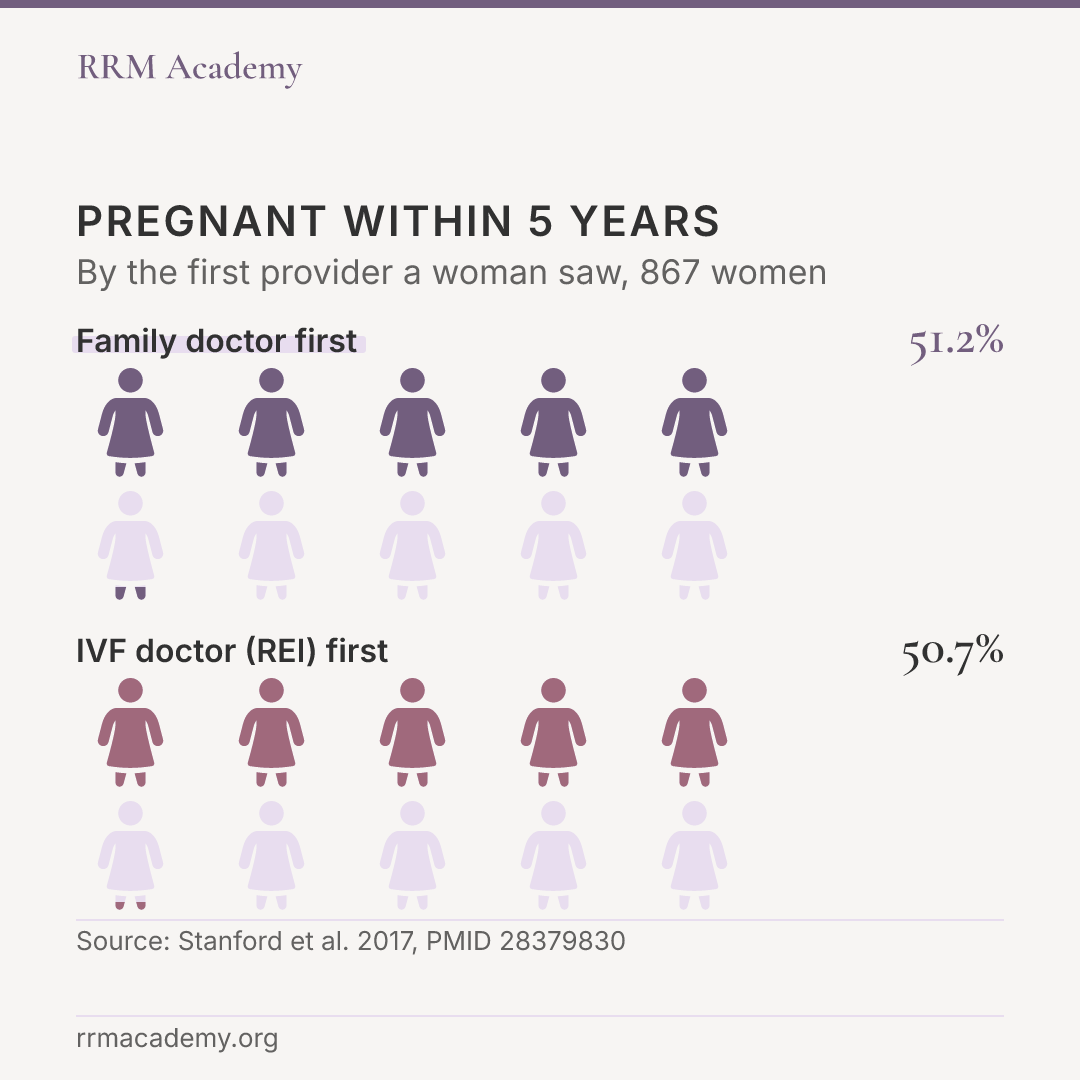
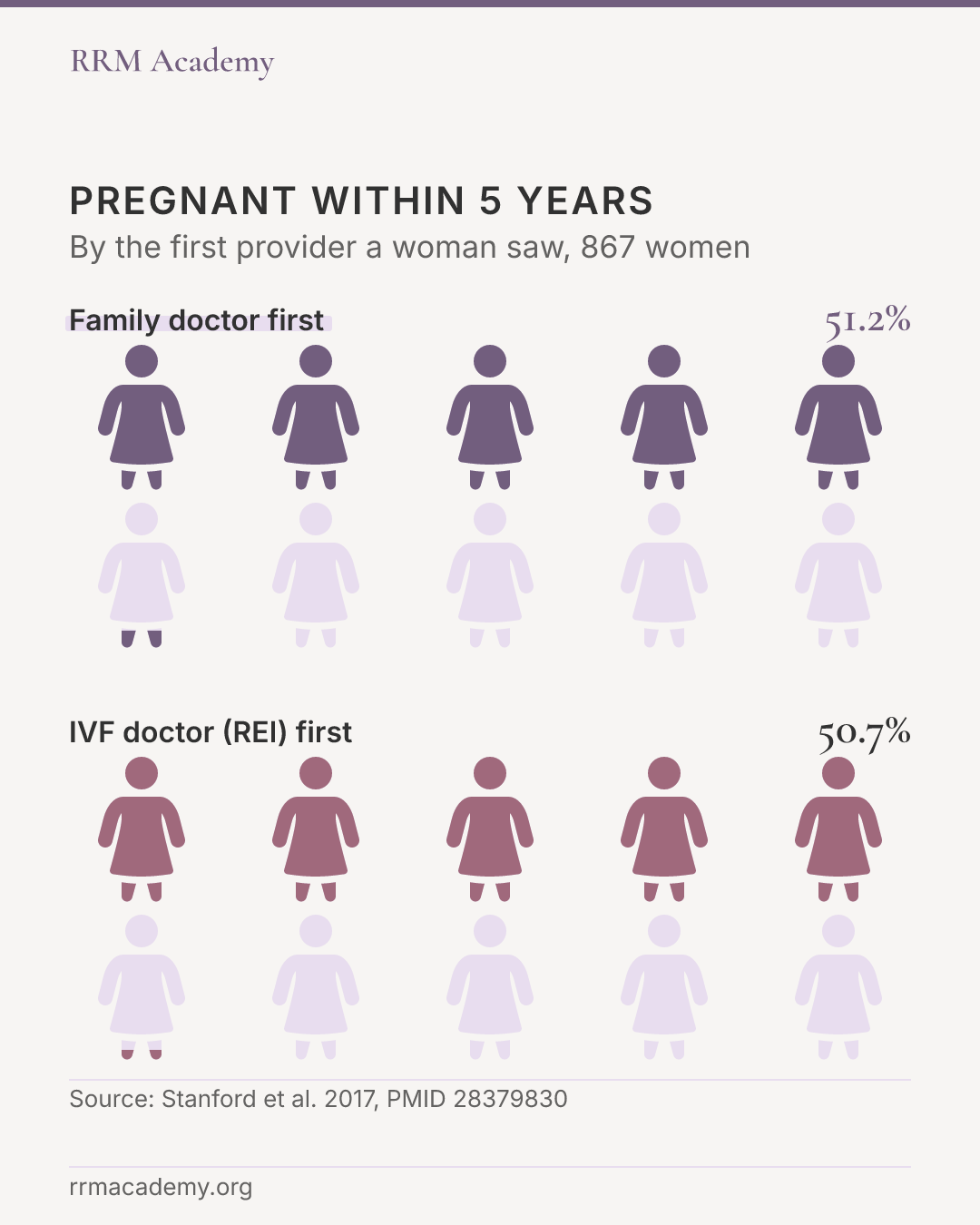
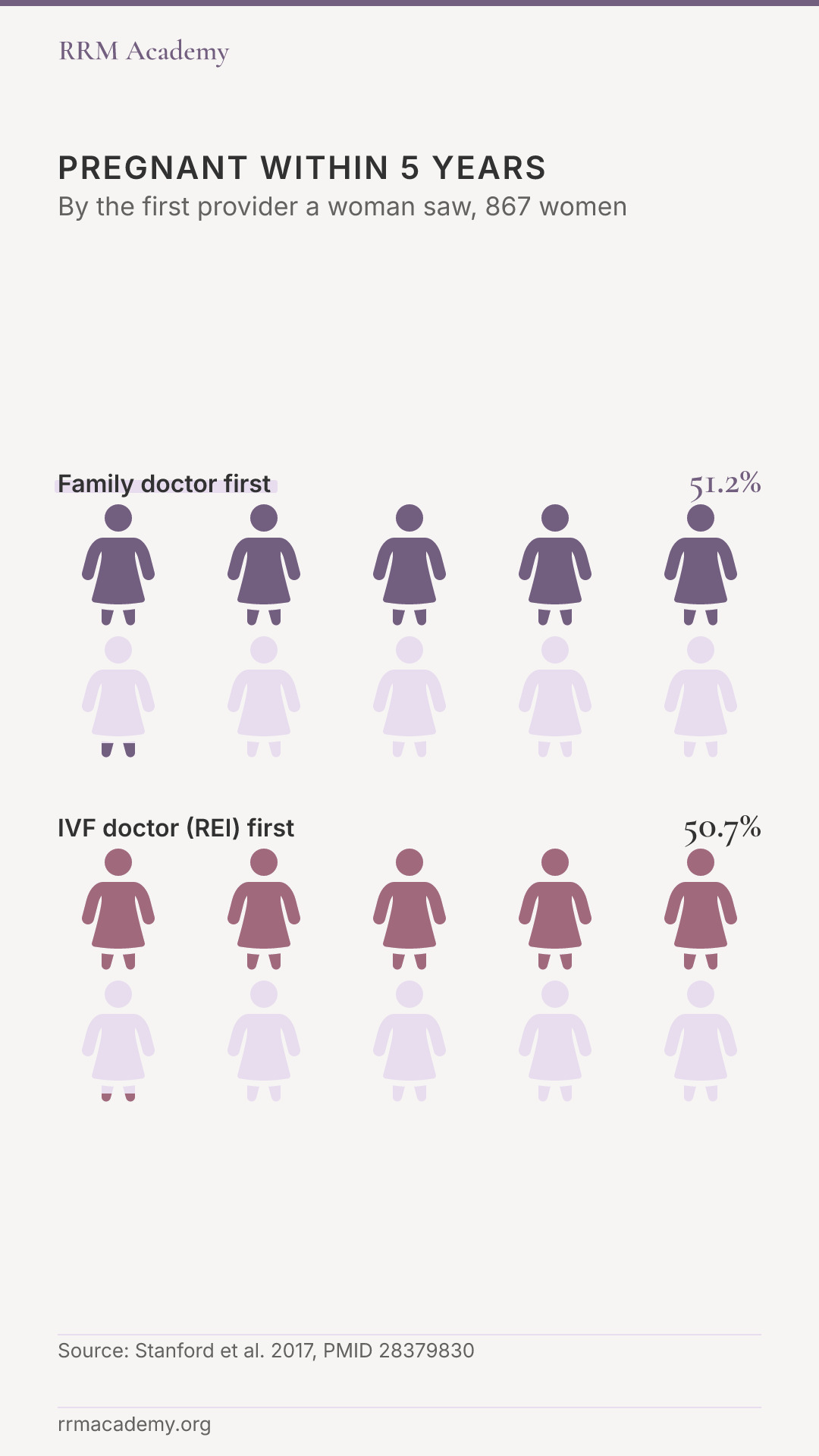
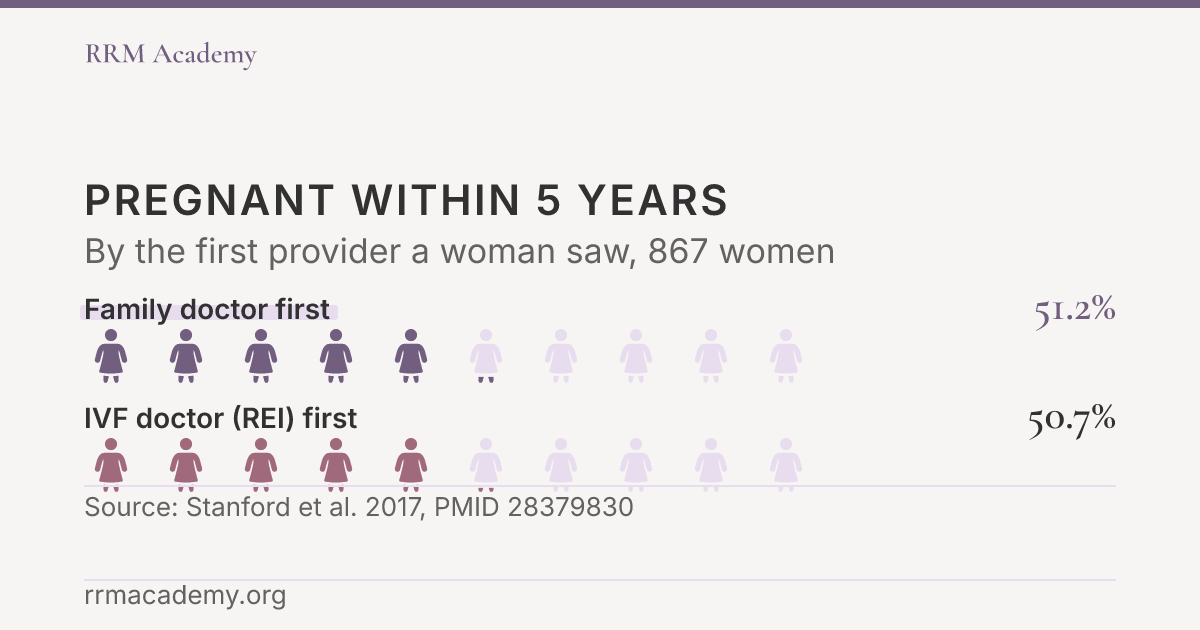
51.2% of women who started with a generalist got pregnant within the first 5 years of trying. For those who started with an IVF doctor it was 50.7%.
Among the 553 women who had a live birth, median time to that pregnancy was 35 months in the generalist group. It was 31 months in the IVF doctor group.
Live birth did not differ significantly by which provider a woman saw first.
Interpretation
This is a retrospective cohort: women reported their past fertility care in questionnaires and interviews. The design shows association without establishing causation. The authors say women who start with different providers likely differ in ways not measured, such as the cause of infertility. The 67 women who saw an IVF doctor (a reproductive endocrinologist) first were older and had tried longer. Women classed their own providers, so some OB-GYN clinics with an infertility focus may count as IVF doctors. The IVF result is an odds ratio, with no IVF share per group. All 867 lived in Utah, and 76% were Latter-day Saint. The study reports only the woman's care.
RRM Context
This study measured where couples start. The study did not measure what a full workup would have found. The choice still matters. Most couples are already sitting in a generalist's office when the trouble begins, and that visit decides a great deal. Restorative reproductive medicine starts from a different question: what is causing this? Ovulation problems, thyroid and other hormone conditions, endometriosis, and male factor are nameable causes. IVF goes around them and leaves them in place. Unexplained infertility usually means undiagnosed.
Our editorial summary of this paper, not the article's abstract.
Abstract
Purpose
To explore the relationship between the type of clinician (generalist vs subspecialist) initially seen by infertile women, the treatment received, and the time to pregnancy.
Methods
We analyzed mixed-mode questionnaire data from 867 women with primary infertility enrolled into a retrospective cohort through population- and fertility clinic-based sampling. We compared women presenting first to generalist providers with women presenting first to fertility subspecialists, with the main outcomes of receiving in vitro fertilization (IVF), time to pregnancy, and live birth.
Results
The first contact for most (84%) women with infertility was a generalist provider. Only 8% of women sought care first from a fertility subspecialist, and these women were older and had been trying longer to conceive. Women who presented first to a generalist provider were less likely to receive IVF (adjusted odds ratio, 0.48; 95% confidence interval, 0.28-0.82), were equally likely to achieve pregnancy, and had similar times to pregnancy (adjusted hazard ratio, 1.11; 95% confidence interval, 0.80-1.53) compared with women who presented first to a subspecialist.
Conclusions
Generalist providers are frequently the first point of care for women with difficulty conceiving and are uniquely positioned to promote the balanced management of infertility.
Minjeur M et al., 2026·Journal of Restorative Reproductive Medicine·Free to read
Infertility is a clinical condition that is recognized by the symptom of an inability to conceive through sexual intercourse or to sustain a pregnancy, with that symptom indicating underlying male and/or female pathology.
This definition of infertility was developed through a structured, consensus-informed process involving broad stakeholder engagement. Initially, multiple definitions currently used by various medical professional organizations were reviewed, and a definition document was drafted and submitted to the Board of Directors of the International Institute for Restorative Reproductive Medicine (IIRRM). All IIRRM members were invited to provide feedback on the draft. Approximately 2,500 individuals and 44 organizations from 92 countries were then invited to review the proposed document, representing clinical, scientific, patient, policy, and advocacy perspectives. Submitted comments were reviewed thematically, with suggested revisions evaluated for clarity, clinical relevance, inclusiveness, and consistency with contemporary restorative reproductive medicine. Following this review, 3 substantive changes, 18 minor changes, and 15 citation corrections were incorporated into the final draft which resulted in a revised definition intended to better reflect the medical, social, and practical realities of modern infertility evaluation and care. Final approval by the IIRRM Board of Directors was unanimous.
Kahn LG et al., 2026·JAMA Network Open·Free full text on PubMed Central
Increasing numbers of children are conceived using infertility treatment; concerns remain about potential effects on child neurodevelopment. To evaluate whether infertility treatment is associated with child neurodevelopment and whether such an association may be attributable to underlying subfecundity. DESIGN, SETTING, This cohort study was conducted among mother-child dyads in the National Institutes of Health Environmental Influences on Child Health Outcomes (ECHO) Cohort, with infants conceived between 1998 and 2022. Associations of subfecundity and infertility treatment with neurodevelopmental outcomes were assessed among children ages 2 to 10 years. Data were analyzed from May 14, 2025, to March 31, 2026. Subfecundity was defined as prior consultation for, treatment of, or diagnosis of infertility for either partner; at least 2 prior miscarriages; or ever having had unprotected heterosexual intercourse for 12 months without conceiving. Infertility treatment was categorized as in vitro fertilization (IVF) or non-IVF treatment. Harmonized caregiver responses to the Strengths and Difficulties Questionnaire and the Child Behavior Checklist yielded continuous raw scores for externalizing and internalizing problems. The total raw Social Responsiveness Scale (SRS) score quantified autism-like symptoms. Caregivers reported physician diagnosis of autism spectrum disorder (ASD) and attention deficit/hyperactivity disorder (ADHD). Among 15 382 mother-infant dyads, there were 14 191 unique maternal participants (mean [SD] age at delivery, 30.9 [5.33] years; 8780 parous participants [57.1%]). ASD and ADHD were diagnosed in 876 offspring (7.6%) and 819 offspring (7.1%), respectively. In generalized linear models, subfecundity was associated with higher externalizing problem and SRS scores among all pregnancies (externalizing problems: b = 0.47 [95% CI, 0.14-0.81]; SRS score: b = 1.08 [95% CI, 0.01-2.14]) and when restricted to natural conceptions (externalizing problems: b = 0.45 [95% CI, 0.07-0.83]; SRS score: b = 1.12 [95% CI, -0.09 to 2.34]). Offspring of parents with subfecundity had higher odds of ASD (overall: odds ratio [OR], 1.27 [95% CI, 1.03-1.57]; natural conceptions: OR, 1.31 [95% CI, 1.04-1.64]). Children conceived via non-IVF treatment had higher odds of ADHD compared with those conceived via natural conception with subfecundity (OR, 1.77 [95% CI, 1.16-2.68]) or without subfecundity (OR, 1.54 [95% CI, 1.05-2.25]). There were no significant associations for IVF treatment. In this large US cohort study, subfecundity was associated with elevated scores for caregiver-reported symptoms of behavioral problems and higher odds of ASD diagnosis, independent of infertility treatment. Non-IVF treatment was associated with ADHD, warranting further research into specific indications for treatment that may increase risk of offspring neurodevelopmental problems.
Stanford JB et al., 2026·Frontiers in Reproductive Health·Free full text on PubMed Central
Background The total fertility rate (TFR) in most developed countries has been declining for decades. In the United States (U.S.), the total fertility rate has remained below replacement level since 2007. Subfertility affects at least 15% of women or couples over their reproductive lifespan and contributes to reduced TFR. Restorative reproductive medicine (RRM) is a medically based approach to subfertility care that can be delivered in primary care settings to increase live birth rates. Objective To estimate the theoretical impact of use of RRM among subfertile couples in the United States. Methods We conducted a simulation study. Model inputs included the number of women of reproductive age in the United States by 5-year age groups; current age-specific and total fertility rates; the proportion of women in each age group with subfertility; estimated spontaneous live birth rates among women with subfertility; and age-specific crude live birth rates with RRM treatment. We evaluated fifteen scenarios including sensitivity analyses: two different varying assumptions for spontaneous conception (25% vs. 50%), two levels of RRM utilization among subfertile women (20% vs. 50%), three different estimates of the number of subfertile women who would be potentially eligible for RRM treatment, and 4 different levels of effectiveness (live birth) from RRM treatment. Results The baseline TFR in the United States was 1.77 during 2015-2019, and 13.5% of women ages 20-44 were estimated to have subfertility. In a conservative scenario (50% spontaneous births; 20% RRM utilization; married women trying to conceive for at least 12 months, 20.7% RRM live births), the TFR increased to 1.79, representing a 1.0% relative increase (absolute +0.02). In an optimistic scenario (25% spontaneous births; 50% RRM utilization; all subfertile women), the TFR increased to 2.02, a 14.5% relative increase (absolute +0.26), approaching replacement-level fertility. Conclusion Simulation results suggest that expanding access to RRM within primary care settings could meaningfully increase the U.S. TFR, by reducing unresolved subfertility. Realizing this potential would require policy and health system changes to address workforce capacity, insurance coverage, and equitable access. These findings underscore the potential contribution of non-IVF fertility care pathways in addressing population-level fertility decline.
To determine whether IVF or a standard infertility treatment algorithm results in better outcome and/or lower cost when used as first-line therapy for couples with infertility. Prospective, randomized clinical study. University-affiliated infertility clinic. PATIENT(S): Couples with newly diagnosed infertility and no prior treatment. INTERVENTION(S): Couples were randomized to undergo either IVF (group 1, n = 46) or a standard infertility treatment algorithm (group 2, n = 50) as initial therapy for infertility. MAIN OUTCOME MEASURE(S): Pregnancy rates and costs per couple, per month of treatment, and per pregnancy. RESULT(S): Pregnancy rates were higher in group 2 than in group 1. Costs per couple were not statistically different, although a trend toward higher costs was apparent in group 1, reflected by a higher median cost per clinical pregnancy established and a higher cost per month of treatment. Whereas cost differences between the groups diminished over time, pregnancy rates remained the same. CONCLUSION(S): In vitro fertilization currently does not represent an appropriate first-line treatment option for couples with infertility. The use of a standard infertility treatment algorithm results in a higher pregnancy rate and lower cost and therefore should be the preferred treatment approach.
Infertility is a significant problem with multiple causes and a corresponding array of therapeutic options. In an era of increasing assisted reproductive treatments, few studies examine the role of conventional non-assisted reproductive treatments to address underlying behavioural, lifestyle and medical issues. To assess outcomes from a conventional or non-assisted reproductive treatment approach. Retrospective case series of 162 couples that attended an Australian, hospital-based, multidisciplinary fertility clinic between 2005 and 2010. There were 58 live births for all couples giving a crude live birth rate of 35.4% over a 24-month analysis period. When adjusted by Kaplan-Meier method, a 57.4% cumulative live birth rate (CLBR) was achieved. Couples had a median 33.9 months duration of infertility and the median female age was 33.7. For the 74 couples with an unexplained infertility diagnosis, 32 achieved a live birth at a crude rate of 43.2% or 71.2% CLBR when adjusted by Kaplan-Meier method. This observational data indicates that reproductive medicine should have a personalized approach in which alternatives for immediate IVF are considered.
Hinton L et al., 2012·Br J Gen Pract·Free full text on PubMed Central
Infertility affects 9% of couples in the UK. Most couples who visit their GP because they are worried about their fertility will ultimately conceive, but a few will not. Treatment usually happens in secondary care, but GPs can have an invaluable role in starting investigations, referring, and giving support throughout treatment and beyond. To inform clinical practice by exploring primary care experiences of infertility treatment among females and males, and discussing findings with a reference group of GPs to explore practice experience. DESIGN AND A qualitative patient interview and GP focus group study. Interviews were conducted in patients homes in England and Scotland; the focus group was held at a national conference. An in-depth interview study was conducted with 27 females and 11 males. A maximum variation sample was sought and interviews were transcribed for thematic analysis. Results were discussed with a focus group of GPs to elicit their views. Feeling that they were being taken seriously was very important to patients. Some felt that their concerns were not taken seriously, or that their GP did not appear to be well informed about infertility. The focus group of GPs highlighted the role of protocols in their management of patients who are infertile, as well as the difficulty GPs faced in communicating both reassurance and engagement. Simple things that GPs say and do, such as describing the 'action plan' at the first consultation, could make a real difference to demonstrating that they are taking the fertility problem seriously.
Bernot G et al., 2025·European Journal of Obstetrics & Gynecology and Reproductive Biology
Fertility treatment pathways are complex and lengthy. The current prevalence of infertility makes it a public health issue. The involvement of general practitioners and the training of fertility instructors to provide therapeutic education have been suggested as ways of involving patients in the process and improving the therapeutic trajectory of these patients, who often have co-morbidities. To describe the activity of trained fertility instructors; to assess the interest of doctors in the fertility chart provided by women; and to describe the outcomes of their fertility care pathway. 66 French fertility instructors were interviewed in June 2024. The 15 general practitioners who had received additional training were also interviewed. The records of all couples who received fertility counselling and treatment between 1 January 2022 and 31 December 2023, the study cut-off date, were analysed. Doctors declared that the women had gained a clear understanding of their menstrual cycle, which was useful for diagnosis and treatment follow-up. The chart was particularly useful for diagnosing the causes of infertility and identifying when in the cycle to take medication. Only 4 of the 551 women were lost to follow-up. Of the remaining 547 women, 204 (37%) became pregnant. Of these, 75% had a live birth or an ongoing pregnancy at study cut-off. The involvement of fertility instructors and general practitioners improved the couple s ability to interact with doctors and to adhere to infertility treatment. The fertility chart provided by the women proved to be useful in the diagnosis and treatment process.
Assisted Reproduction › Outcomes and Effectiveness › Live Birth Rates
Jessica N Sanders, Joseph B Stanford, Mandy W Boltz
Jess Sanders, J Sanders, Joe Stanford, Joey Stanford, J Stanford, M Boltz
PMID 28379830 28379830 DOI 10.3122/jabfm.2017.02.160184 10.3122/jabfm.2017.02.160184 Boltz et al. 2017, Boltz 2017
Cite this article
Boltz, M. W., Sanders, J. N., Simonsen, S. E., & Stanford, J. B. (2017). Fertility Treatment, Use of in Vitro Fertilization, and Time to Live Birth Based on Initial Provider Type. Journal of the American Board of Family Medicine : JABFM, 30(2), 230-238. https://doi.org/10.3122/jabfm.2017.02.160184
Boltz MW, Sanders JN, Simonsen SE, Stanford JB. Fertility Treatment, Use of in Vitro Fertilization, and Time to Live Birth Based on Initial Provider Type. J Am Board Fam Med. 2017;30(2):230-238. doi:10.3122/jabfm.2017.02.160184
Boltz, M. W., et al. "Fertility Treatment, Use of in Vitro Fertilization, and Time to Live Birth Based on Initial Provider Type." Journal of the American Board of Family Medicine : JABFM, vol. 30, no. 2, 2017, pp. 230-238.
Keywords
Adult, Female, Fertilization in Vitro/statistics & Numerical Data, General Practitioners, Humans, Infertility, Female/therapy, Live Birth, Odds Ratio, Pregnancy, Retrospective Studies, Surveys and Questionnaires, Time-to-Pregnancy, Treatment Outcome, Female; Live Birth; Point-of-Care Systems; Pregnancy; Retrospective Studies; Surveys and Questionnaires; Time-to-Pregnancy, Fertilization; Fertilization in Vitro; Infertility