
What is the Marquette Method?
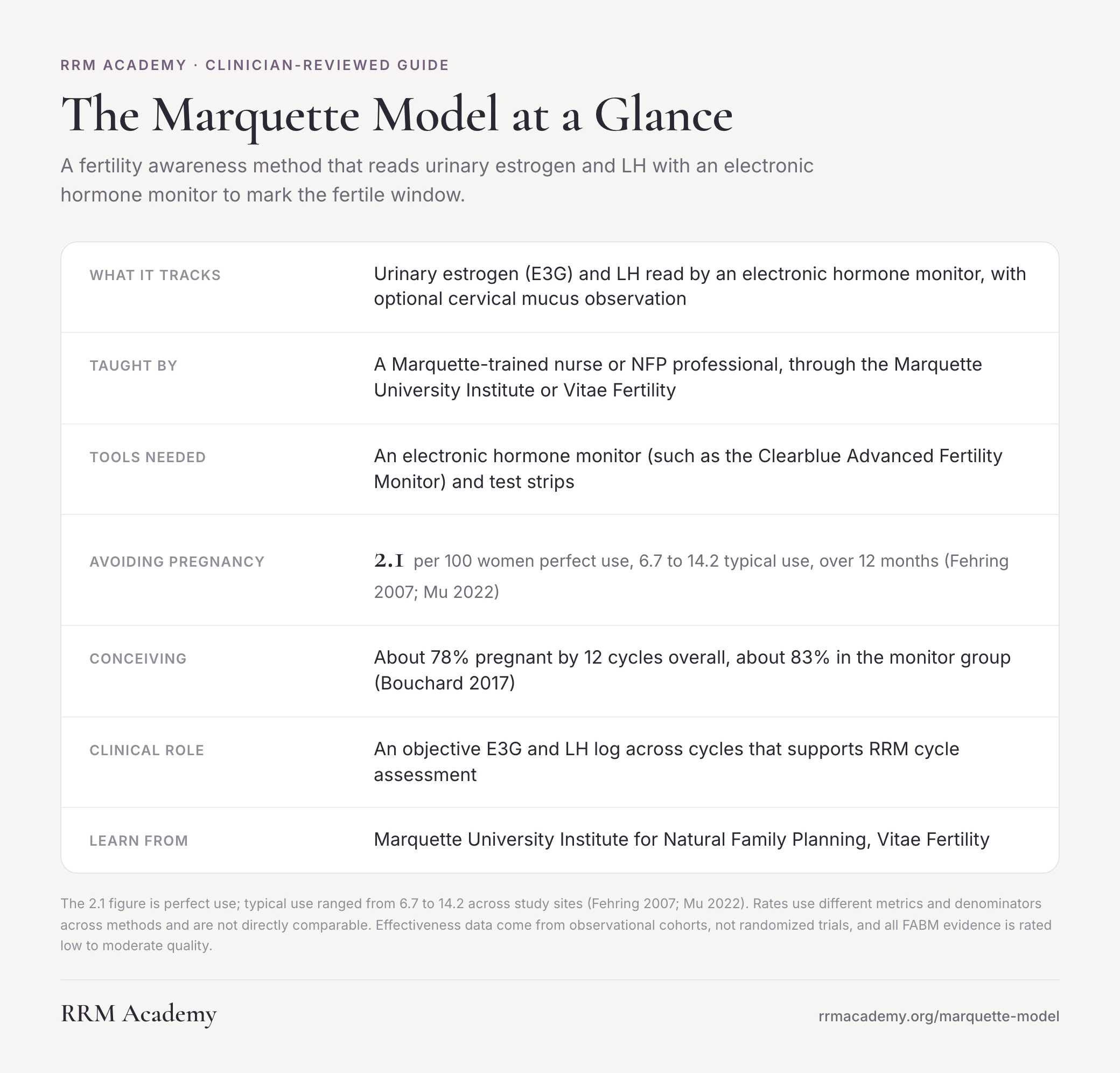
The Marquette Method is a fertility awareness-based method (FABM) that uses an electronic hormone monitor to detect urinary estrogen (E3G) and luteinizing hormone (LH). Those two hormone signals mark the approach and peak of the fertile window with objective data. A rising E3G reading signals that ovulation is approaching. A detected LH surge signals that ovulation is imminent. Together, they tell the couple where they are in the cycle without relying solely on the interpretation of physical signs.
Cervical mucus observation can be added as a second layer. When both biomarkers are used together, the monitor's hormone data and the mucus signal tend to confirm each other, and the combined picture is more informative than either signal alone.
The Marquette Method sits within the broader field of fertility awareness-based methods. For couples already familiar with NaProTechnology and the Creighton Model, Marquette offers a distinct but related approach: the biomarker is urinary hormone levels rather than cervical mucus characteristics. The clinical data the monitor produces can support cycle assessment in the same restorative framework.
How does the Marquette Method work?
The monitor reads test strips dipped in the first-morning urine sample. It analyzes estrogen and LH concentrations and displays a reading: Low, High, or Peak. Low indicates the pre-fertile phase. High signals rising estrogen as ovulation approaches. Peak signals the LH surge, the 24-to-48-hour window just before ovulation occurs.
The couple tracks these daily readings, with or without a parallel cervical mucus observation. The combination of High and Peak days defines the fertile window the method identifies. After the Peak reading, the post-ovulatory infertile phase begins.
Because the monitor reads hormone levels directly from urine, it produces the same kind of reading regardless of cycle length or irregularity. A long cycle still shows a detectable LH surge when it occurs. A short cycle shows the surge earlier. The method follows the biology rather than a calendar assumption.
The monitor's readings can also be shared with a clinician as part of a cycle evaluation. The objective data show what estrogen and LH did across that cycle, which provides a documented basis for clinical assessment that does not depend on the couple's interpretation of mucus observations.
How is the Marquette Method taught?
The Marquette Method is taught by a Marquette-trained nurse or NFP professional, not learned from an app or self-study alone. Instruction typically includes an introduction to the monitor, guidance on reading and recording results, and follow-up sessions as the couple learns to apply the method to their own cycle patterns.
The primary training organization is Marquette University (its Institute for Natural Family Planning, now the Boland Institute for Natural Family Planning), which provides the instructor training. Professional certification, the Marquette Method Certified Professional (MMCP) credential, is conferred by the Marquette Method Professionals Association (MMPA). Vitae Fertility is a US teaching provider whose instructors are MMPA-certified. These organizations can connect couples with a qualified instructor.
Instruction matters for two reasons. First, the monitor requires correct use: consistent first-morning urine, correct strip handling, and proper recording. Second, the couple needs to understand what the readings mean and how to apply them to family-planning decisions. An instructor trained in the method can address cycle variations, postpartum transitions, and other situations where the standard protocol needs individual application.
How effective is the Marquette Method?
A 2007 study found a perfect-use rate of about 2.1 per 100 women over 12 months when the Marquette Method's rules were followed correctly and consistently (Fehring 2007). That figure represents how reliable the hormone-signal rules are when couples follow them. It does not represent what a typical user experiences.
Typical-use rates were about 6.7 per 100 women over 12 months in a 1,221-woman multisite study and 14.2 in an earlier 195-woman trial, reflecting the variation that emerges in real-world use when instructions are not always followed perfectly (Mu 2022; Fehring 2007). The gap between perfect and typical use is large, as it is for every FABM. What a couple actually does with the fertile-window information drives their real-world result.
What is the Marquette Method used for?
The Marquette Method is used for two primary purposes: avoiding pregnancy and achieving pregnancy. The same fertile-window data that tells a couple when to avoid intercourse also tells them when to time it for conception.
For couples working to avoid pregnancy, the monitor readings define which days to avoid intercourse. Following those guidelines consistently is what drives the method toward its perfect-use rate. When couples make exceptions on identified fertile days, real-world rates move toward the typical-use range.
For couples trying to conceive, the High and Peak readings identify the days most likely to result in fertilization. Timing intercourse around the LH surge is the Marquette approach to fertility targeting. No calendar estimate is required. The monitor reads what the body is actually doing on that cycle.
A third application is cycle documentation for clinical assessment. When the monitor readings are recorded across several cycles, they create a log of how estrogen rose, when the LH surge occurred, and how consistent the pattern was. An RRM clinician reviewing that record can assess whether the cycle is producing normal hormone signals or whether the pattern warrants further evaluation. That clinical application connects Marquette monitoring to the broader restorative-medicine framework.
How the Marquette Method supports restorative reproductive medicine
Restorative reproductive medicine works from cycle data. The cycle is a vital sign. What that vital sign shows matters clinically. The Marquette Method contributes objective urinary hormone data to that picture.
For many couples, mucus observation is clear and interpretable. For others, identifying mucus characteristics precisely is difficult, particularly during post-pill transitions, postpartum recovery, or cycles affected by underlying conditions. In those situations, the monitor's hormone readings provide a signal that does not depend on the couple's ability to interpret mucus. The two biomarkers can be used together, and when they agree, the clinical picture is stronger.
RRM clinicians work from what the cycle shows. A documented log of E3G and LH readings across multiple cycles is information the clinician can assess. If the LH surge is consistently weak, delayed, or absent, that is a clinical signal. If estrogen rises normally but the LH surge is blunted, that is a different clinical signal. The monitor makes those patterns visible in a form that is objective and reproducible.
The method does not tell the clinician what to do with those findings. That is the clinician's job. But it gives the clinician data that charting from memory or calendar estimates cannot provide. In that sense, Marquette monitoring is consistent with the restorative principle of working with the body's physiology rather than bypassing or suppressing it. For couples and clinicians seeking evaluation, the provider directory connects to RRM-trained clinicians who can interpret cycle data in a restorative framework.
How to learn the Marquette Method
The starting point is finding a trained Marquette instructor. The method is not designed for self-directed learning from a consumer app. An instructor trained through the Marquette University Institute or Vitae Fertility teaches the couple how to use the monitor, record readings, interpret the results in the context of their cycle, and apply the guidelines to their specific situation.
The Marquette University Institute for Natural Family Planning offers instructor training and maintains a directory of certified instructors. Their website is the best starting point for finding a Marquette teacher in the United States or internationally.
Vitae Fertility trains and supports Marquette instructors with a focus on integrating the method with fertility care, including for couples working with RRM clinicians.
For couples interested in connecting Marquette monitoring to a restorative reproductive medicine evaluation, the next step is finding a clinician trained in RRM who can assess what the cycle data shows. The RRM Academy provider directory lists clinicians working in this framework.
Continue exploring
References
- Fehring RJ, Schneider M, Raviele K, Barron ML. Efficacy of cervical mucus observations plus electronic hormonal fertility monitoring as a method of natural family planning. Journal of Obstetric, Gynecologic and Neonatal Nursing. 2007;36(2):152-160. PMID 17371516.
- Mu Q, Fehring RJ, Bouchard T. Multisite effectiveness study of the Marquette Method of natural family planning program. The Linacre Quarterly. 2022;89(1):64-72. PMID 35321484.
- Bouchard TP, Fehring RJ, Schneider MM. Achieving pregnancy using primary care interventions to identify the fertile window. Frontiers in Medicine. 2018;4:250. PMID 29376054.
Frequently Asked Questions
How accurate is the Marquette Method for avoiding pregnancy?
Published research reports a perfect-use rate of about 2.1 per 100 women over 12 months when the method's rules are followed correctly and consistently (Fehring 2007). Typical-use rates were about 6.7 per 100 women over 12 months in a 1,221-woman multisite study and 14.2 in an earlier 195-woman trial (Mu 2022; Fehring 2007). The gap between those two numbers reflects what happens in real-world use when the fertile window is not consistently avoided. Consistent adherence to the method's guidelines is the primary driver of effectiveness. Instruction from a trained Marquette teacher supports that consistency. Consult an RRM clinician for guidance specific to your situation.
Can I learn the Marquette Method from an app or on my own?
In many cases, self-directed use of the monitor without instructor guidance leads to lower effectiveness. The Marquette Method is designed to be taught by a trained nurse or NFP professional who can review cycle data, address irregular patterns, and adjust application to the couple's situation. The hormone monitor provides objective readings, but understanding how to apply those readings to family-planning decisions across different cycle types requires instruction. Marquette University provides the instructor training, the Marquette Method Professionals Association (MMPA) confers the certification (the MMCP credential), and Vitae Fertility is a teaching provider whose instructors are MMPA-certified. Consult an RRM clinician for guidance specific to your situation.
Does the Marquette Method work if my cycles are irregular?
In many cases, irregular cycles do not prevent using the Marquette Method. The hormone monitor detects the actual LH surge when it occurs, regardless of when in the cycle it happens. A long or unpredictable cycle still produces a detectable hormone signal. The method follows the biology rather than a calendar assumption, which is one of its advantages for women with variable cycle lengths. That said, irregular cycles can sometimes involve hormone patterns that are more difficult to interpret, and close instructor follow-up matters in those situations. Consult an RRM clinician for guidance specific to your situation.
Can the Marquette Method help with trying to conceive?
In many cases, yes. Among couples using primary-care interventions to identify the fertile window, about 78% achieved pregnancy by 12 cycles overall, rising to about 83% in the group using the hormonal monitor alone (Bouchard 2018). The monitor identifies the High and Peak days that mark the fertile window, giving couples objective data to time intercourse rather than relying on calendar estimates. For couples working with an RRM clinician, the hormone readings across several cycles can also support clinical assessment of whether the cycle is producing normal ovulatory signals. The restorative aim is to find and address the underlying cause of difficulty conceiving, not bypass it. Consult an RRM clinician for guidance specific to your situation.
How does Marquette compare to mucus-only methods like Creighton?
The Marquette Method adds urinary hormone monitoring as its primary biomarker, where mucus-only methods like the Creighton Model rely entirely on cervical mucus observation. Marquette can include mucus observation as an optional second layer, and when both signals agree, the picture is stronger. For some women, mucus observation is difficult to interpret consistently, particularly during post-pill transitions or postpartum recovery. In those situations, the monitor's hormone readings provide an objective signal that does not depend on mucus interpretation. A side-by-side comparison of FABMs is available at Fertility Awareness Methods Compared. Consult an RRM clinician for guidance specific to your situation.
Can Marquette hormone data be used in a restorative medicine evaluation?
In many cases, yes. The monitor produces a documented record of how estrogen rose and when the LH surge occurred across each cycle. RRM clinicians working in a restorative framework can review that record as part of a cycle assessment. Patterns such as a consistently weak LH surge, delayed ovulation, or absent hormone peaks are clinically informative. The monitor does not diagnose conditions or recommend treatment. That is the clinician's role. But the objective hormone data it generates gives an RRM clinician more to work with than a patient's recollection or a calendar estimate. To connect with a clinician trained in restorative reproductive medicine, visit Find a Provider. Consult an RRM clinician for guidance specific to your situation.
This content is for educational and reference purposes only and does not constitute medical advice, diagnosis, or treatment. Consult a qualified clinician about your specific situation.