What is the Sympto-Thermal Method?
The sympto-thermal method (STM) is a fertility awareness-based method (FABM) that combines two biological signals: cervical mucus observation and basal body temperature (BBT). Some protocols also include cervix position and texture as a third, optional sign. Read together, these biomarkers cross-check each other, which is the defining feature of the sympto-thermal approach.
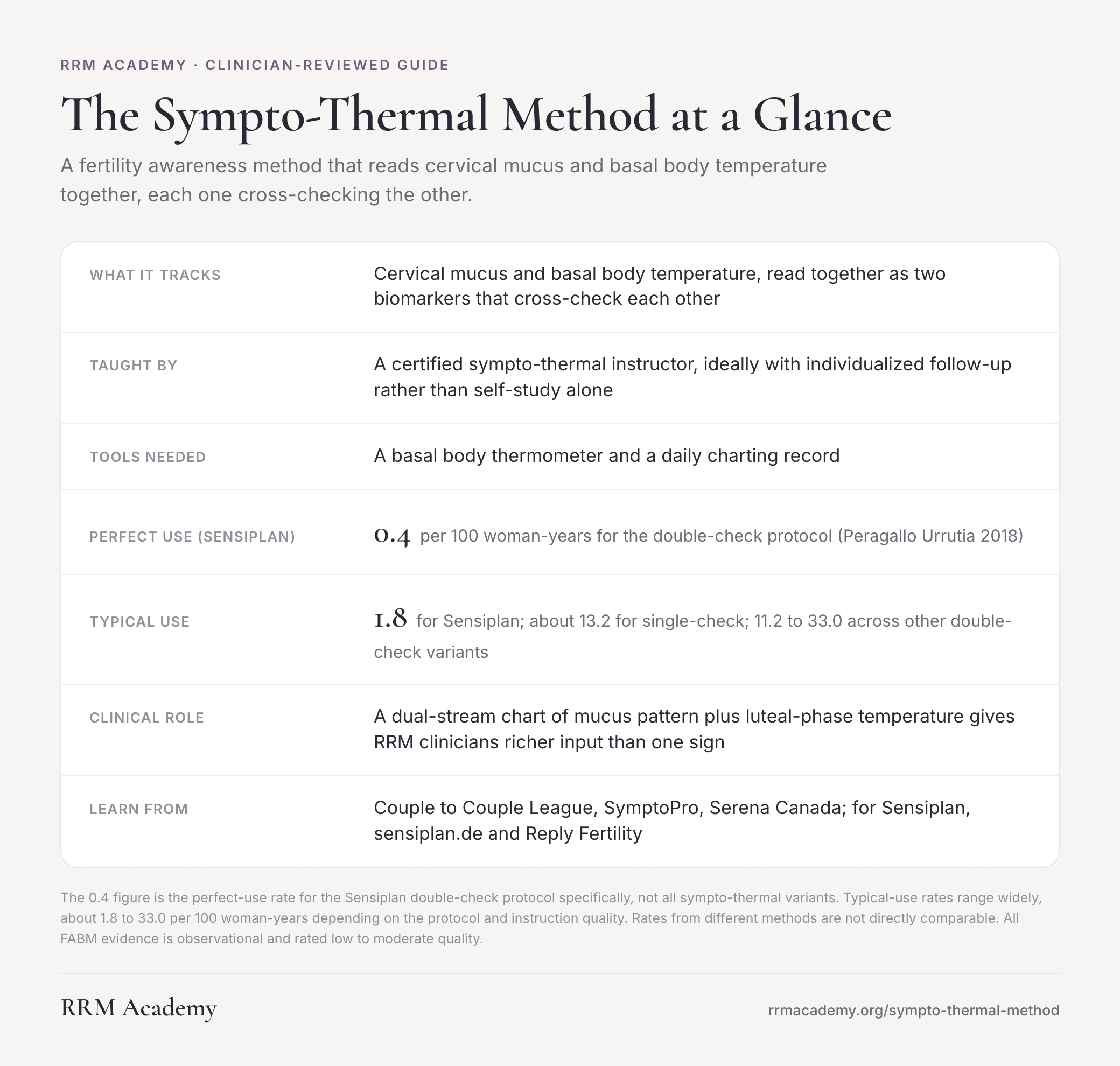
STM is a method, not a single branded program. Several teaching organizations offer instruction in STM-based charting, including the Couple to Couple League (CCL, ccli.org), the largest nonprofit natural family planning provider in the United States; SymptoPro Fertility Education, affiliated with Northwest Family Services (symptopro.org); and Serena Canada (serena.ca). These are teaching organizations. They share the sympto-thermal method's core biomarker logic while differing in instructional framework, charting conventions, and organizational lineage.
One specific STM protocol deserves separate attention: Sensiplan, developed in Germany by the Arbeitsgruppe NFP. Sensiplan uses a defined double-check rule and has the strongest evidence base of any STM protocol. Because the effectiveness figures most often cited for STM come from Sensiplan, this guide covers it in detail in The Sensiplan protocol section below.
How does the Sympto-Thermal Method work?
STM works by tracking two physiological changes that bracket the ovulatory event from opposite ends.
Cervical mucus changes under the influence of rising estrogen as the fertile window approaches. The mucus becomes more abundant, clearer, and develops a stretchy, lubricative quality. This build-up signals the opening of the fertile window. Peak Day, the last day of the most fertile-type mucus, correlates with the LH surge and the ovulatory event, identified retrospectively once the mucus quality shifts back.
Basal body temperature (BBT) records a different biological signal. BBT is the body's resting temperature, taken first thing in the morning before any activity. After ovulation, progesterone from the corpus luteum causes a sustained rise in BBT, typically 0.2 degrees Celsius or more above the pre-ovulatory baseline. This temperature shift confirms that an ovulatory event has occurred.
The cross-check principle is what makes STM distinctive. The mucus pattern signals the approach and arrival of the fertile window; the temperature shift confirms the post-ovulatory phase from the other side. In most STM protocols, the post-ovulatory infertile phase is declared only when both signs independently support that conclusion. No single biomarker alone makes the call.
One precision point matters for clinical interpretation: a BBT rise and a mucus pattern shift signal an ovulatory event. They do not confirm that a healthy egg was actually released. True ovulation confirmation requires serial ultrasound, watching the follicle grow and then collapse, or pregnancy. Some women with normal-looking charts have luteinized unruptured follicles (LUF), a finding relevant to undiagnosed subfertility. RRM clinicians who receive a sympto-thermal chart are reading a record of a presumed ovulatory event, not a confirmed egg release.
Charting requires a basal body thermometer and a daily recording habit. Temperature is taken at the same time each morning, before getting up, and after at least three hours of uninterrupted sleep. Illness, alcohol, disrupted sleep, and shift work affect BBT readings and require careful notation to interpret the pattern accurately.
How is the Sympto-Thermal Method taught?
STM instruction is available through several organizations. The Couple to Couple League (ccli.org) is the largest nonprofit NFP teaching organization in the United States and has offered sympto-thermal instruction since 1971. SymptoPro Fertility Education, affiliated with Northwest Family Services (symptopro.org), offers STM instruction with a particular focus on challenging cycles and health integration. Serena Canada (serena.ca) has taught STM in Canada since 1955 and offers instruction in both English and French.
These organizations are not separate methods. They teach the same underlying sympto-thermal framework, with variations in charting conventions, instructional structure, and organizational context. Instructor quality and the depth of case management vary between programs. Couples with irregular cycles, post-oral-contraceptive transitions, or fertility goals benefit most from programs that offer individualized follow-up rather than self-study alone.
The most rigorously studied STM protocol, Sensiplan, has a strict double-check rule and its own English-language teaching organizations, covered in The Sensiplan protocol section below.
How effective is the Sympto-Thermal Method?
STM has real effectiveness data, and stating it honestly requires separating perfect use from typical use, and separating the Sensiplan protocol from other STM variants. These numbers are not interchangeable.
Perfect use (method-related effectiveness). When the rules are followed exactly, the strongest STM data comes from the Sensiplan double-check protocol. A 2018 systematic review tabulated a perfect-use rate of approximately 0.4 pregnancies per 100 woman-years for Sensiplan, among the lowest of any FABM (Peragallo Urrutia et al. 2018). That figure derives from the large German cohort of Frank-Herrmann et al. 2007 (900 women, 17,638 cycles).
Typical use. In that same Sensiplan cohort, the typical-use rate was 1.8 pregnancies per 100 women over 13 cycles (Frank-Herrmann et al. 2007). That is one of the strongest typical-use rates in the FABM literature.
Why STM effectiveness is not a single number. The same 2018 systematic review examined STM variants across the published literature. Typical-use rates were approximately 13.2 per 100 woman-years for single-check sympto-thermal methods. For double-check variants, the range was 11.2 to 33.0 per 100 woman-years, with the Sensiplan protocol achieving 1.8 (Peragallo Urrutia et al. 2018). The spread is large. The specific rules, the strictness of the double-check requirement, and the quality of instruction drive the result. A protocol that allows more ambiguity in interpretation produces higher typical-use failure rates.
Evidence quality. All FABM effectiveness data is observational. No randomized controlled trials exist for any FABM. This is a genuine limitation on certainty. It applies symmetrically: the typical-use rates for oral contraceptives and condoms that appear in every family-planning comparison table also come from cohort and life-table studies, not from randomized trials. The standard applies to all methods, not selectively to FABMs.
The honest summary: when the double-check rules are followed carefully, STM, particularly the Sensiplan protocol, is among the most effective FABMs studied. Effectiveness depends directly on instruction quality, consistent daily practice, and strict application of the method rules.
What is the Sensiplan protocol?
Sensiplan is the most rigorously studied sympto-thermal protocol, and the effectiveness figures cited for STM throughout this guide come from it. It was developed in Germany by the natural family planning research group Arbeitsgruppe NFP, and it is the standard sympto-thermal method taught across much of Europe.
What sets Sensiplan apart is a strict double-check rule: the post-ovulatory infertile phase is declared only when both the temperature shift and the cervical mucus shift independently confirm it. Neither sign alone is sufficient. That redundancy is the main reason its published failure rates are among the lowest of any fertility awareness-based method.
The evidence comes from a large prospective German cohort of 900 women contributing 17,638 cycles, which found a perfect-use rate of about 0.4 and a typical-use rate of 1.8 pregnancies per 100 women over 13 cycles (Frank-Herrmann et al. 2007; Peragallo Urrutia et al. 2018). Those numbers describe the Sensiplan protocol specifically, not every sympto-thermal program.
Sensiplan is widely available in Germany and Europe and more limited in the United States. Because it is a specific protocol rather than a generic sympto-thermal approach, look for an instructor who teaches Sensiplan by name. English-language instruction is available through the official Sensiplan organization (sensiplan.de/en) and, in the United States, through Reply Fertility.
What is the Sympto-Thermal Method used for?
STM serves three related purposes.
Avoiding pregnancy. Couples identify the fertile window from the combined mucus and temperature record and avoid genital contact on those days. Effectiveness depends on consistent adherence to the method rules and the quality of instruction received.
Targeting conception. The mucus pattern identifies the approach of the fertile window, and the temperature record confirms that the ovulatory event has occurred. Couples trying to conceive use the mucus signal to time intercourse toward the most fertile days rather than guessing from a calendar.
Health monitoring and clinical input. A sympto-thermal chart over several cycles reveals information about the ovulatory cycle that a calendar cannot: whether ovulation is occurring, how the post-ovulatory phase is structured, what the luteal phase temperature pattern looks like, and whether cycle-to-cycle patterns suggest anything worth investigating. This is where STM intersects with restorative reproductive medicine.
How the Sympto-Thermal Method supports restorative reproductive medicine
For an RRM clinician, a sympto-thermal chart provides more clinical information than a single-biomarker record. The mucus column and the temperature column together tell two different parts of the same biological story.
The mucus pattern shows what happened approaching and through the ovulatory event: the build-up, the Peak Day, the shift to the post-Peak phase. The temperature record shows what happened after: whether the luteal phase temperature rise was sustained, how long it lasted, and what the thermal shift looked like. Cycle-timed laboratory evaluation can be anchored to that record rather than to a calendar estimate, enabling more accurate characterization of where in the cycle a given hormone value was obtained.
This dual-stream record is richer clinical input than a single sign. A clinician reading a sympto-thermal chart is not flying blind. The chart is a signal to read, not a variable to eliminate.
STM charting sits within the broader principle that restorative reproductive medicine applies to all cycle-charting-based care: cooperate with the physiology, support the ovulatory cycle, and read what the body is communicating before drawing clinical conclusions. For the clinical framework that most formally integrates cycle charting with medical evaluation, see NaProTechnology.
For clinical evaluation and care, visit Find a Provider.
How to learn the Sympto-Thermal Method
Finding a qualified instructor is the most important first step. STM is not well-served by self-teaching alone, particularly for couples with irregular cycles, health concerns, or fertility goals. Structured instruction and individualized chart review matter for both effectiveness and clinical utility.
Organizations that offer STM instruction:
- Couple to Couple League (ccli.org): the largest nonprofit NFP teaching organization in the United States. Offers home-study courses and local chapter instruction.
- SymptoPro Fertility Education / Northwest Family Services (symptopro.org): offers certified instructor training and patient instruction with a health-integration focus.
- Serena Canada (serena.ca): offers STM instruction across Canada in English and French, with roots going back to 1955.
For Sensiplan specifically, the most evidence-supported protocol, see the Sensiplan protocol section below, which lists its English-language teaching organizations.
For a clinician-reviewed comparison of all major FABM methods, visit Fertility Awareness Methods Compared.
For RRM clinical evaluation and care, visit Find a Provider.
Continue exploring
References
- Frank-Herrmann P, Heil J, Gnoth C, et al. The effectiveness of a fertility awareness based method to avoid pregnancy in relation to a couple's sexual behaviour during the fertile time: a prospective longitudinal study. Human Reproduction. 2007;22(5):1310-1319. PMID 17314078.
- Peragallo Urrutia R, Polis CB, Jensen ET, et al. Effectiveness of fertility awareness-based methods for pregnancy prevention: a systematic review. Obstetrics and Gynecology. 2018;132(3):591-604. PMID 30095777.
Frequently Asked Questions
What makes the sympto-thermal method different from other FABMs?
The defining feature of STM is the cross-check principle. Most FABMs rely on a single biomarker: cervical mucus only (as in the Creighton Model and Billings), or a urinary hormone monitor (as in Marquette). STM uses two independent biological signals, cervical mucus and basal body temperature (BBT), read together. Some protocols add cervix position and texture as a third, optional sign.
The cross-check matters because each biomarker captures a different phase of the ovulatory event. Mucus signals the approach of fertility from the pre-ovulatory side. Temperature confirms the post-ovulatory phase from the other side. When both signs independently support the conclusion that the infertile post-ovulatory phase has begun, the confidence in that determination is stronger than either sign alone could provide.
For a full comparison of FABMs by biomarker, evidence base, and clinical use, see Fertility Awareness Methods Compared.
How effective is the sympto-thermal method?
STM effectiveness depends heavily on which protocol is used and how carefully its rules are followed. The numbers are not interchangeable across STM variants.
The most rigorously studied STM protocol is Sensiplan. A large German cohort of 900 women across 17,638 cycles found a typical-use rate of 1.8 pregnancies per 100 women over 13 cycles, and a 2018 systematic review tabulated a perfect-use rate of about 0.4 for that protocol. Those are among the strongest figures in the FABM literature.
The same 2018 review found wide variation across STM variants: typical-use rates of about 13.2 per 100 woman-years for single-check methods, and a range of 11.2 to 33.0 for other double-check variants. Protocol rigor, instruction quality, and consistent rule application are the primary drivers of the outcome.
All FABM effectiveness data is observational. This limitation applies equally to the comparator methods in every family-planning comparison table. The Sensiplan protocol, where the strongest figures come from, is covered in its own section on this page.
Is STM the same as the Billings Method or Creighton Model?
No. Both Billings and the Creighton Model are single-biomarker methods: they use cervical mucus only, without basal body temperature. STM combines mucus and temperature as two independent checks. That dual-biomarker cross-check is the structural difference.
Within the STM family, there are also meaningful variations: some protocols use a single post-Peak temperature confirmation rule; others, like Sensiplan, require a double-check rule before declaring the post-ovulatory infertile phase. Those differences affect the effectiveness data. This guide covers the Sensiplan double-check protocol in its own section.
Marquette is a separate method that uses a urinary hormone monitor rather than mucus and temperature observation. It has a different evidence base and a different learning pathway.
Do I need an instructor, or can I learn STM on my own?
In many cases, working with a trained instructor produces better outcomes than self-teaching, particularly for couples with health concerns, irregular cycles, post-oral-contraceptive transitions, or fertility goals. The temperature interpretation rules, the mucus observation protocol, and the cross-check logic all take time to internalize correctly. Errors in temperature-taking technique, mucus classification, or rule application affect real-world effectiveness directly.
Certified instructors are available through the Couple to Couple League (ccli.org), SymptoPro Fertility Education (symptopro.org), and Serena Canada (serena.ca). For the Sensiplan protocol specifically, the Sensiplan section of this guide lists its English-language teaching organizations.
For clinical evaluation using a sympto-thermal chart in a restorative reproductive medicine context, visit Find a Provider.
Can STM be used if my cycles are irregular?
In many cases, yes. STM reads actual biological signals rather than making calendar assumptions. The mucus pattern and the temperature shift occur in response to the real hormonal events of the cycle, wherever those events fall. Irregular cycles, long cycles, and variable cycle lengths do not disqualify STM use.
That said, irregular cycles create more variability in chart interpretation. Pre-ovulatory phases can be unpredictable in length, which means more days of uncertain or abstinent status before the temperature rise confirms the post-ovulatory phase. Structured instruction and chart review with an experienced teacher matter more with irregular cycles, not less.
If irregular cycles are associated with an underlying condition, a restorative reproductive medicine clinician can evaluate the chart in that context. Visit Find a Provider to find a clinician.
How does a sympto-thermal chart help an RRM clinician?
A sympto-thermal chart gives a clinician two biomarker streams rather than one. The mucus column records the pre-ovulatory and peri-ovulatory phase: when the fertile-type mucus appeared, when Peak Day occurred, and how the mucus shifted afterward. The temperature column records the post-ovulatory phase: when the temperature rise began, how sustained it was, and what the luteal phase length looked like.
That combined record allows cycle-timed laboratory evaluation anchored to the chart's biological landmarks rather than to a calendar estimate. The length and character of the luteal phase temperature rise can prompt specific clinical questions. Patterns across multiple charts can suggest conditions worth investigating.
The chart is a signal to read, not a variable to eliminate. For the clinical framework that most formally integrates sympto-thermal charting with medical evaluation, see NaProTechnology. To find a clinician, visit Find a Provider.
This content is for educational and reference purposes only and does not constitute medical advice, diagnosis, or treatment. Consult a qualified clinician about your specific situation.