What is the TwoDay Method?
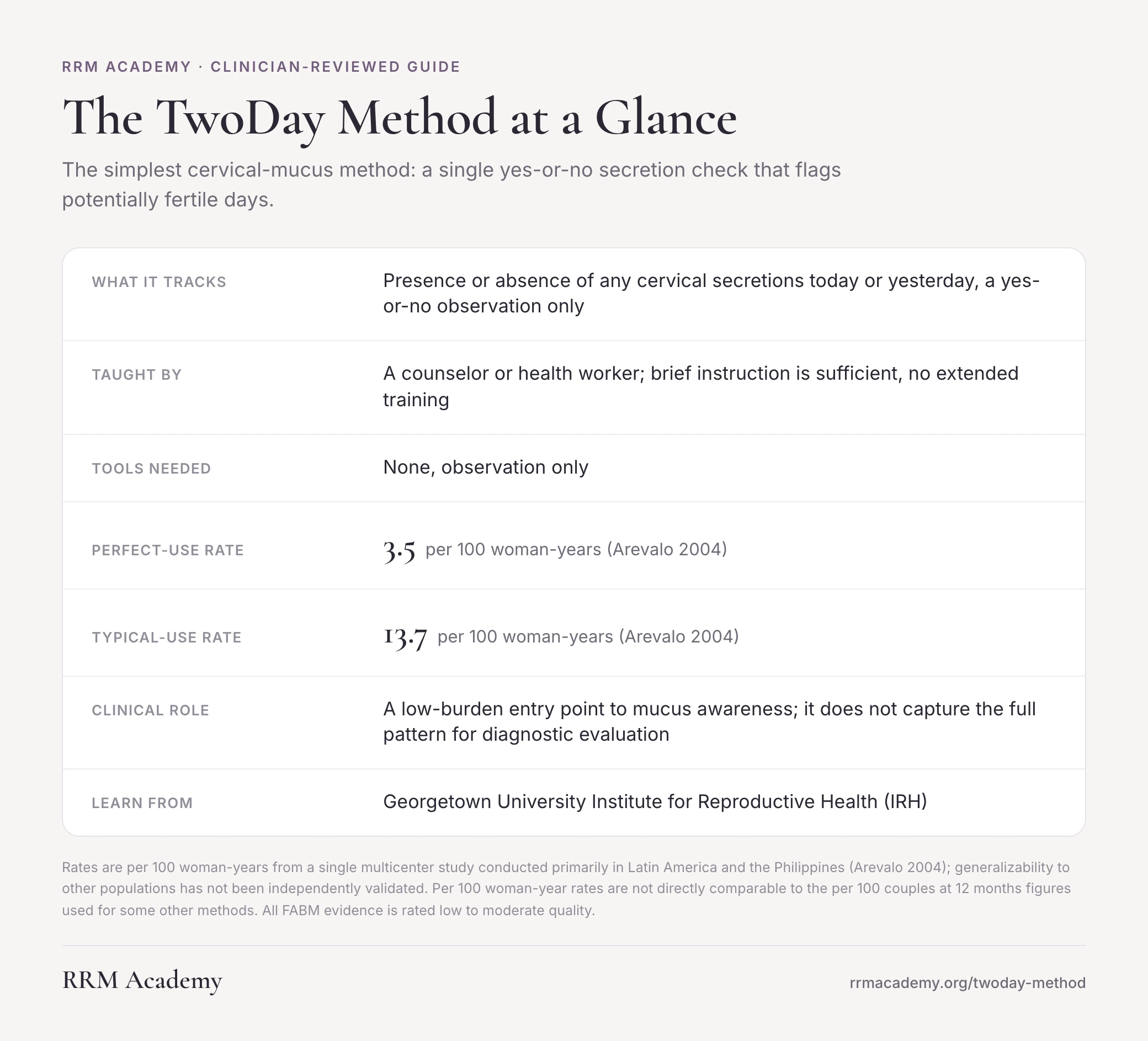
The TwoDay Method is a fertility awareness-based method built on a single daily question. Were any cervical secretions present today? Were any present yesterday? If the answer is yes to either, the couple treats the day as potentially fertile and avoids unprotected intercourse. If the answer is no to both, the couple considers the day infertile. That is the complete rule.
No thermometer. No charting vocabulary. No hormone monitor. No stamps or color codes. The TwoDay Method strips cervical-mucus awareness down to its simplest possible form: a binary observation anyone can make without tools or extended training.
The method belongs to the family of fertility awareness-based methods (FABMs). It focuses on the presence of secretions as a signal of potential fertility, without asking the user to characterize those secretions in detail. That simplicity is the method's defining feature. It is also its ceiling.
How does the TwoDay Method work?
The underlying biology is the same as in more detailed mucus-based methods. As the body approaches ovulation, the cervix produces secretions that signal the fertile window. The TwoDay Method captures the presence of those secretions without requiring the user to assess their appearance, stretch, or sensation quality.
Each evening, the user asks two questions: Did I notice any secretions today? Did I notice any secretions yesterday? If the answer is yes to either question, the couple avoids unprotected intercourse. If the answer is no to both, they consider the day infertile.
The two-day window is intentional. Secretions can be intermittent, and asking only about the current day would miss days that follow a brief dry interval within an active fertile phase. The look-back to yesterday reduces the risk of misclassifying a fertile day as infertile.
The method does not identify the specific fertile window within the cycle. It identifies days when secretions are present or were recently present. Those days are treated as potentially fertile. Days with no secretions for two consecutive days are treated as infertile.
How is the TwoDay Method taught?
Brief instruction from a counselor or health worker is sufficient to learn the TwoDay Method. The Georgetown University Institute for Reproductive Health (IRH) developed and tested the method and continues to support training and dissemination. IRH's research informed the effectiveness data that forms the evidence base for the method.
The method was designed specifically for settings where extended professional training is not available. A single instruction session is typically enough. This is a meaningful distinction from instructor-led methods like the Creighton Model, which require ongoing follow-up visits across the first year of use.
For learning resources and provider information, the Georgetown University Institute for Reproductive Health is the primary institutional source: irh.org.
How effective is the TwoDay Method?
The published effectiveness data for the TwoDay Method comes from a single multicenter study conducted primarily in Latin America and the Philippines. Arevalo et al. 2004 reported a perfect-use rate of 3.5 per 100 woman-years and a typical-use rate of 13.7 per 100 woman-years.
Those two numbers belong together. Perfect-use measures what happens when the rule is followed exactly every day. Typical-use measures what happens in practice, where some days are missed, some rules are bent, and life intervenes. The gap between 3.5 and 13.7 is large. It reflects what the research consistently shows across FABMs: the method works when used correctly, and real-world use is often imperfect.
The study population was drawn mainly from Latin America and the Philippines. Generalizability to other populations has not been independently validated in method-specific trials. That is a real limitation and this guide names it directly.
The TwoDay Method is one of the simplest FABMs. That is its main strength and its main limitation. It is accessible where more complex methods are not. It does not capture the full mucus pattern, which means it cannot serve the diagnostic function that fuller charting methods provide within restorative reproductive medicine.
What is the TwoDay Method used for?
The TwoDay Method is primarily a family-planning tool for avoiding pregnancy. It can also be used by couples trying to conceive: days when secretions are present are days of potential fertility, and the method helps identify that window without requiring detailed charting.
The method is well suited to low-resource settings, to women who are new to cycle awareness and want a simple entry point, and to situations where brief rather than extended instruction is available. It is one of the simplest fertility awareness-based methods published in the peer-reviewed literature.
What the TwoDay Method does not do: it does not generate a detailed mucus record that a clinician can read as a diagnostic tool. It does not characterize the secretion pattern across the cycle. It does not provide the kind of longitudinal ovulatory data that supports clinical evaluation within restorative reproductive medicine. For couples seeking that depth, a fuller mucus-charting method is the appropriate next step. See the FABM comparison guide for an overview of the options.
How the TwoDay Method supports restorative reproductive medicine
Within restorative reproductive medicine, the TwoDay Method functions as a low-burden entry point to cervical-mucus awareness. Some couples begin here. The act of noticing secretions at all, of paying attention to the body's cycle signals rather than ignoring them, is a meaningful first step toward body literacy.
That entry point has real value. It is not, however, the clinical foundation that RRM evaluation builds on. RRM clinicians working with couples on fertility, cycle irregularity, or reproductive conditions need the full secretion pattern across the cycle, not just a daily yes-or-no. The diagnostic utility of mucus charting comes from the pattern: when secretions appear, what they look like, how they change through the cycle, and when they resolve after peak. The TwoDay Method does not capture that detail.
For couples who want to move from the TwoDay Method toward a fuller charting approach, an RRM clinician can help identify the right method and connect them with appropriate instruction. Clinical care and evaluation are available through RRM-trained clinicians listed at rrmacademy.org/providers/. For a deeper look at the restorative framework, the NaProTechnology guide explains how detailed mucus charting informs clinical evaluation.
How to learn the TwoDay Method
The TwoDay Method is taught through brief instruction from a trained counselor or health worker. The Georgetown University Institute for Reproductive Health (IRH) is the primary institutional source for training materials and provider support: irh.org.
For couples interested in a fuller mucus-charting method that can serve as the basis for restorative reproductive medicine evaluation, the FABM comparison guide describes the available options. To connect with an RRM clinician, visit rrmacademy.org/providers/.
Continue exploring
References
- Arevalo M, Jennings V, Nikula M, Sinai I. Efficacy of the new TwoDay Method of family planning. Fertility and Sterility. 2004;82(4):885-892. PMID 15482764.
Frequently Asked Questions
How does the TwoDay Method work?
The TwoDay Method uses a single daily observation. Each evening, the user asks two questions: Were any cervical secretions present today? Were any present yesterday? If the answer is yes to either question, the day is treated as potentially fertile and the couple avoids unprotected intercourse. If the answer is no to both, the day is considered infertile.
No tools are needed. No charting vocabulary to learn. The two-day look-back reduces the risk of misclassifying a fertile day during a brief interruption in secretions. The method identifies presence or absence of secretions only; it does not assess their quality or pattern.
Consult an RRM clinician for guidance specific to your situation.
How effective is the TwoDay Method at preventing pregnancy?
The published data comes from one multicenter study conducted primarily in Latin America and the Philippines. Arevalo et al. 2004 reported a perfect-use rate of 3.5 per 100 woman-years and a typical-use rate of 13.7 per 100 woman-years. Perfect-use measures correct, consistent application of the rule. Typical-use reflects real-world practice, where some days are missed or the rule is applied inconsistently.
The gap between those two numbers is meaningful. Effectiveness in the real world depends heavily on how consistently a couple follows the method each day.
Consult an RRM clinician for guidance specific to your situation.
Do I need special tools or apps to use the TwoDay Method?
No tools are required. The TwoDay Method is based entirely on a yes-or-no observation that anyone can make without equipment, apps, thermometers, or charting materials. This is the feature that makes it accessible in low-resource settings and for people new to cycle awareness.
The absence of tools also means the absence of detailed data. The method identifies whether secretions were present; it does not capture the character of the mucus, the pattern across the cycle, or the kind of information that supports clinical evaluation within restorative reproductive medicine. If deeper cycle insight is the goal, a fuller charting method is worth exploring.
Consult an RRM clinician for guidance specific to your situation.
Can the TwoDay Method help when trying to conceive?
In many cases, it can provide a basic signal. Days when secretions are present are days of potential fertility. For couples trying to conceive, those are the days to target. The method identifies the presence of the fertile window without requiring detailed charting.
The limitation is that the TwoDay Method does not produce the kind of detailed mucus record an RRM clinician can use for diagnostic evaluation. It signals that fertile-type secretions are present, but it does not characterize the ovulatory pattern in ways that support clinical assessment of cycle health. Couples seeking that level of evaluation may benefit from a fuller charting method. See the FABM comparison guide for options.
Consult an RRM clinician for guidance specific to your situation.
Who teaches the TwoDay Method?
The method is taught through brief instruction by a counselor or health worker. It does not require extended training from a specialist practitioner. The Georgetown University Institute for Reproductive Health (IRH) developed the method and supports training and dissemination. IRH is the primary institutional source for learning resources.
This brief-instruction model was intentional in the method's design. It was built for settings where access to extended professional instruction is limited. A single teaching session is typically enough to understand and apply the rule.
Consult an RRM clinician for guidance specific to your situation.
Is the TwoDay Method the same as a full mucus-charting method?
No. The TwoDay Method and fuller mucus-charting methods use the same underlying biology but capture very different amounts of information. The TwoDay Method asks only whether secretions were present on the current or previous day. Fuller methods, such as the Creighton Model or Billings Ovulation Method, ask the user to observe and record the quality, appearance, and sensation of secretions across the full cycle.
That additional detail is what allows a clinician to read the chart as a diagnostic record within restorative reproductive medicine. The TwoDay Method is a low-burden entry point to secretion awareness; it is not a substitute for the detailed charting that supports NaProTechnology evaluation. For couples interested in that clinical pathway, a fuller charting method is appropriate. See the FABM comparison guide.
Consult an RRM clinician for guidance specific to your situation.
This content is for educational and reference purposes only and does not constitute medical advice, diagnosis, or treatment. Consult a qualified clinician about your specific situation.