





Practice improvement project, plan-do-study-act format
Systematic Mapping of the Abdomen and Pelvis (S-MAP): a standardized protocol for diagnostic laparoscopy in gynecologic fertility surgery, with a four-case incidental neoplasm series
Poster, 22nd International Clinical and Scientific Congress for Restorative Reproductive Medicine, Orlando, Florida, 9 to 10 October 2026
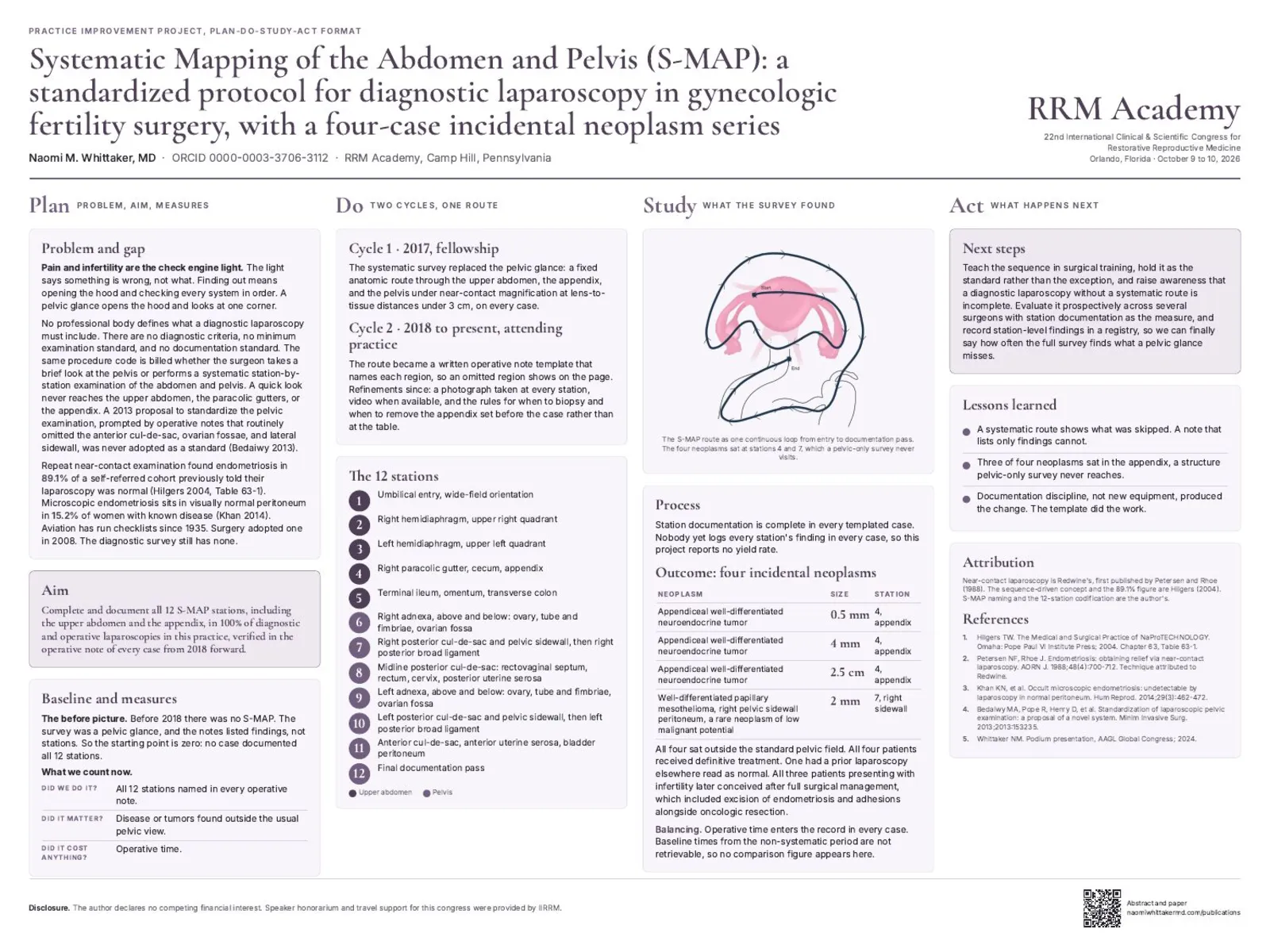
Abstract
No consensus criteria define what constitutes an adequate diagnostic laparoscopy in gynecology. The procedure may be a brief pelvic survey or a systematic station-by-station examination of all abdominal and pelvic structures. The clinical consequences are not equivalent. Near-Contact Laparoscopy (NCL; technique attributed to Redwine, first published by Petersen and Rhoe, AORN J 1988) and a sequence-driven pelvic examination were described in The Medical and Surgical Practice of NaProTechnology (Hilgers, Pope Paul VI Institute Press, 2004), with documented endometriosis identified on repeat near-contact examination in 89.1% of a self-referred cohort previously told their laparoscopy was normal (Chapter 63, Table 63-1). Prospective controlled work has independently shown that visually normal peritoneum harbors microscopic endometriosis in 15.2% of women with known disease (Khan et al., Hum Reprod 2014), supporting the premise that failure to find disease is a technique problem.
This paper has two purposes. First, to introduce the term Systematic Mapping of the Abdomen and Pelvis (S-MAP) and codify a 12-station numbered fixed-order laparoscopic examination protocol that extends the NaProTechnology sequence-driven approach with a mandatory upper-abdomen examination, mandatory appendix examination with explicit appendectomy thresholds, station-resolved photographic and video documentation, defined biopsy thresholds, and integrated adhesion prevention. Second, to demonstrate the protocol's clinical value via a four-case incidental cancer detection series.
S-MAP combines NCL (magnified examination at lens-to-tissue distances under three centimeters) with a 12-station fixed-order sequence covering the upper abdomen, hemidiaphragms, liver, gallbladder, stomach, spleen, paracolic gutters, appendix, terminal ileum, mesentery, peritoneal surfaces, and full pelvis, with photographic documentation, defined biopsy thresholds, and integrated adhesion prevention. The protocol was applied to all diagnostic and operative laparoscopies in a single-surgeon gynecologic fertility surgery practice over a three-year period. Four consecutive incidental neoplasm detections in this practice are reported.
Three rare appendiceal well-differentiated neuroendocrine tumors (sizes 0.5 mm, 4 mm, and 2.5 cm) and one 2 mm well-differentiated papillary mesothelioma of the right pelvic sidewall peritoneum (a rare neoplasm of low malignant potential, distinct from malignant mesothelioma) were incidentally diagnosed and definitively treated. None was within the standard pelvic survey field. All were identified because the examination extended to the appendix, the cecum, and the right pelvic sidewall under near-contact magnification. Standard pelvic-only survey does not visit these anatomic locations and cannot detect lesions there by its design. All four patients were definitively treated. All three patients presenting with infertility subsequently achieved pregnancy following their full surgical management, which included excision of endometriosis and adhesions in addition to oncologic resection.
S-MAP names and codifies a 12-station diagnostic laparoscopy protocol that extends the NaProTechnology sequence-driven approach into a fully-specified examination with mandatory upper-abdomen and appendix evaluation. The four-case cancer detection series demonstrates that S-MAP identifies clinically significant pathology in anatomic locations standard pelvic-only survey does not examine: a paradigm-neutral argument for the protocol's value, independent of disagreements about diagnostic laparoscopy's role in mainstream practice. These findings, alongside previously documented false-negative rates after non-systematic laparoscopy, support prospective multi-surgeon evaluation of S-MAP against current diagnostic laparoscopy practice.
More from RRM Academy
Search the RRM Academy Library for the studies behind this work, or ask RRM AI a clinical question.
