





Theoretical framework
A three-axis framework for reproductive impairment: subfertility, infertility, sterility, and the clinical scope of restorative reproductive medicine
Poster, 22nd International Clinical and Scientific Congress for Restorative Reproductive Medicine, Orlando, Florida, 9 to 10 October 2026
Abstract
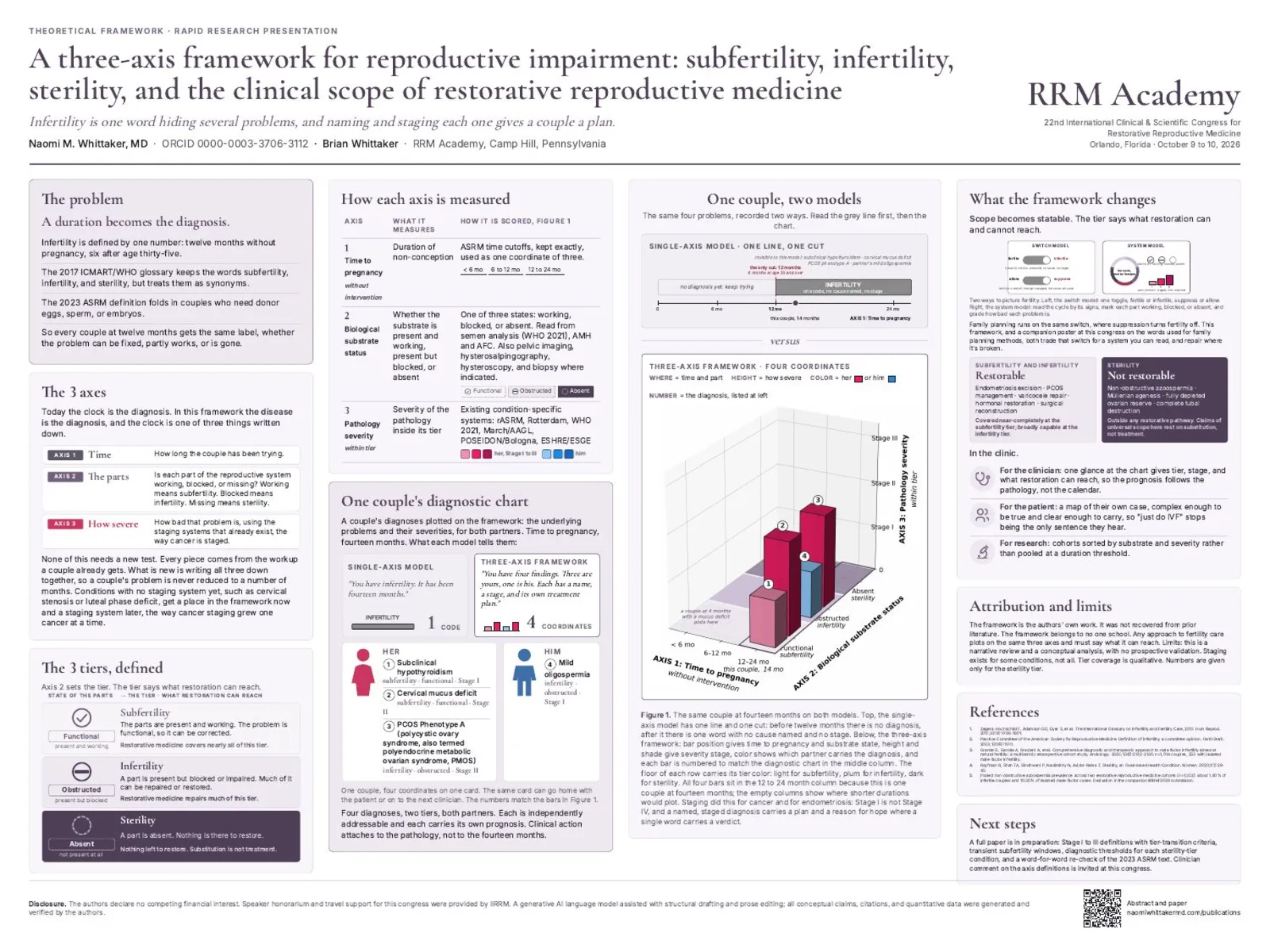
Three terms have long circulated in discourse on reproductive impairment — subfertility, infertility, sterility — but no contemporary professional body treats them as parallel clinical categories. The 2017 ICMART/WHO glossary places them in hierarchical relation, treating subfertility as interchangeable with infertility and sterility as a permanent state of infertility. The 2023 American Society for Reproductive Medicine redefinition collapses the distinctions further, absorbing donor-gamete and donor-embryo cases into the infertility umbrella under an inclusivity rationale — but the analytic effect is to erase the clinical distinction between treating reproductive disease and substituting for absent biological function, and to deny visibility to sterility as a discrete reality patients still inhabit.
To examine the implications of category collapse for the clinical scope of restorative reproductive medicine (RRM), and to propose a parallel three-tier framework distinguished by reversibility of the underlying pathology, with within-tier severity staging where pathology heterogeneity warrants.
Narrative review and conceptual analysis. We propose a three-tier classification of reproductive impairment — subfertility (reduced fertility, natural conception possible), infertility (failure to conceive after twelve months of unprotected intercourse, sporadic conception still possible), and sterility (the irreducible inability to conceive without third-party gametes or biological substitution) — operationalized via three independent quantifiable axes: (1) time-to-pregnancy without intervention (per ASRM); (2) biological-substrate status, a three-state ordinal (present-functional / present-obstructed / absent) composed from existing per-organ diagnostics (semen analysis, AMH/AFC, HSG, pelvic imaging, hysteroscopy); and (3) within-tier pathology severity, staged via existing condition-specific systems where available (rASRM, Rotterdam, WHO 2021, March/AAGL), with the dimensional slot reserved for conditions whose staging remains to be developed. We map major fertility pathologies to each tier and apply a coverage analysis using an Italian multicenter natural-conception cohort (n=1,014 couples; 233 with isolated male-factor infertility) and pooled non-obstructive azoospermia prevalence across two RRM cohorts (n=1,552).
Subfertility is properly understood as a stageable spectrum — often transient, frequently modifiable through behavior, diet, and lifestyle, and a state most adults will encounter at some life stage. RRM provides near-complete coverage at this tier (cycle correction, mucus restoration, mild luteal and ovulatory dysfunction, lifestyle interventions). At the infertility tier, where pathology severity is higher, RRM remains broadly capable (endometriosis excision, PCOS management, varicocele repair, hormonal restoration, surgical reconstruction). Coverage is substantively limited at the sterility tier, where conditions including true non-obstructive azoospermia (~1.80% of infertile couples; 10.30% of isolated male-factor cases), Müllerian agenesis, fully depleted ovarian reserve, complete tubal destruction, and refractory severe Asherman's syndrome fall outside any restorative pathway. Under the umbrella term "infertility," every paradigm — including ART — can appear universally applicable; at the sterility tier this universality is achieved through biological substitution, not biological treatment.
A three-axis framework — time-to-pregnancy, biological-substrate status, and pathology severity — enables honest scope claims by every reproductive-medicine paradigm and accommodates future staging refinement as the field develops it. RRM offers broad coverage of subfertility and infertility and explicitly does not treat sterility. Naming the boundary strengthens the credibility of restorative care and the integrity of patient counseling.
More from RRM Academy
Search the RRM Academy Library for the studies behind this work, or ask RRM AI a clinical question.
