





Methods framework
The ART Reporting Completeness (ARC) Framework: an approach for analyzing how international ART outcome registries report and present results, to support rigorous appraisal and valid comparison studies in restorative reproductive medicine
Poster, 22nd International Clinical and Scientific Congress for Restorative Reproductive Medicine, Orlando, Florida, 9 to 10 October 2026
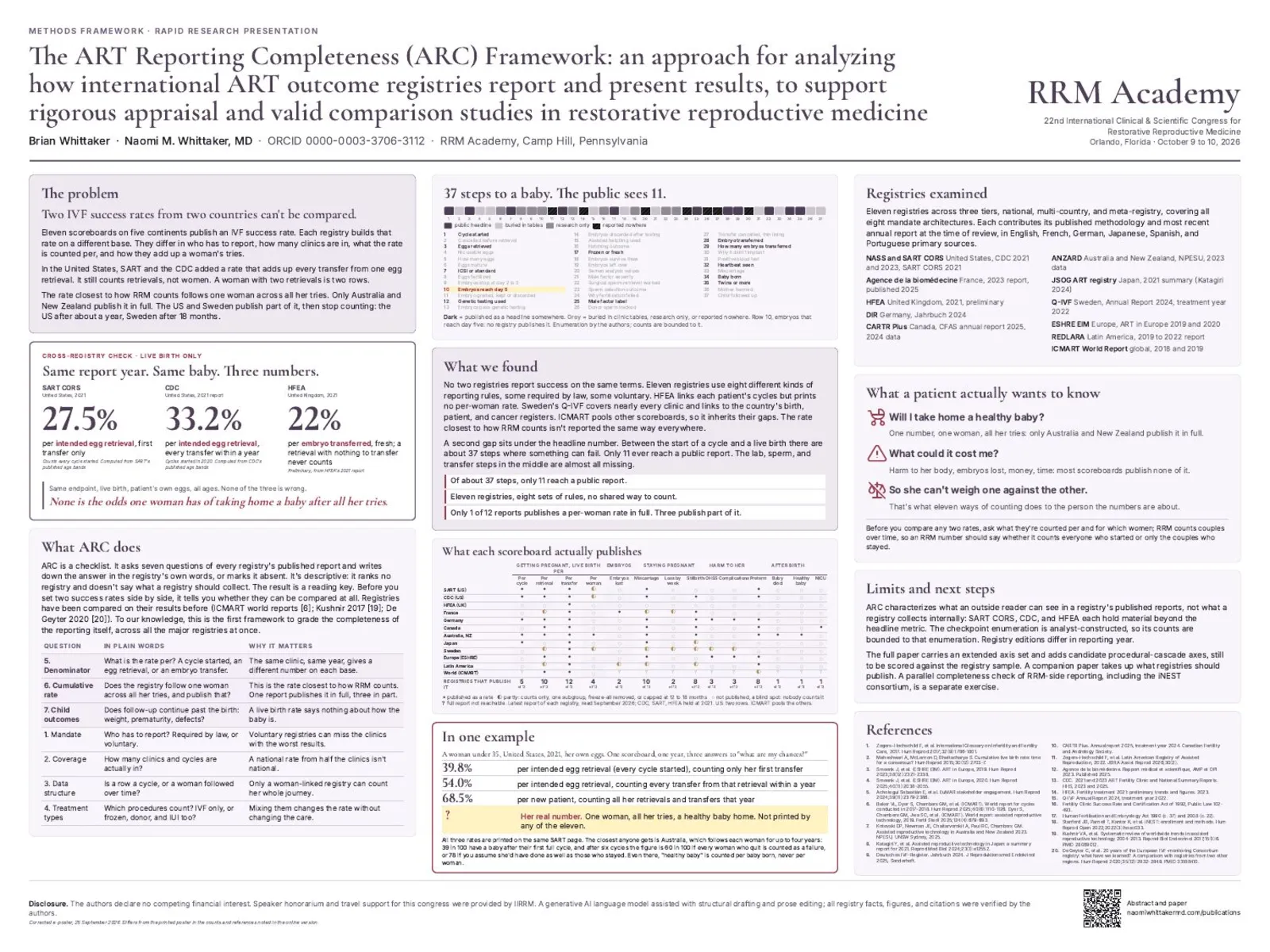
Corrections since printing
The poster shown here is the corrected e-poster of 25 September 2026. The printed poster in Orlando differs in these counts and references:
- The printed poster says three of eleven registries publish a per-woman cumulative live-birth rate, but it names the wrong three: it counts the United States twice and misses Sweden. The correct count is one in full (Australia and New Zealand) and three in part (SART, CDC and Sweden Q-IVF).
- The per-woman column of the coverage grid is redrawn, and its total changes from 6 of 12 to 4 of 12.
- The HFEA 22% figure is births per embryo transferred (fresh). The printed poster called it a rate per fresh embryo transfer. The source is now the HFEA 2021 preliminary report.
- The CDC and SART rates are labelled per intended egg retrieval. The CDC figure covers cycles started in 2020.
- The count of steps visible to the public is 11. The printed poster says 8 to 10.
- References: the Kotevski author list is corrected, Kushnir 2017 and De Geyter 2020 are added, and the CDC and HFEA citations are updated.
Abstract
A central question for restorative reproductive medicine (RRM) is how its outcomes compare with IVF, both in patient counseling and in the published literature. Yet those rates are reported inconsistently and on non-comparable terms across registries. In the United States, for example, SART (reporting year 2014) and the CDC (2017) added a cumulative live-birth rate (CLBR) per intended egg retrieval to the per-cycle, per-retrieval, and per-transfer rates already reported, while a per-patient cumulative rate, the figure most comparable to an RRM cohort, remains unpublished. Knowing what each registry reports and omits is what enables valid comparison, both across registries and against an RRM cohort, and strengthens the foundation for any sound RRM-versus-IVF study.
This study develops the ART Reporting Completeness (ARC) Framework and applies it to eleven major registries spanning national, multi-country, and meta-registry tiers. ARC gives RRM clinicians and researchers a structured way to appraise exactly what each registry's success statistics measure and omit, and to select matched comparators for RRM-versus-IVF comparison studies.
A narrative review was conducted of each registry's published methodology and most recent annual report. The registries examined were NASS and SART CORS (United States), Agence de la biomedecine (France), HFEA (United Kingdom), DIR (Germany), CARTR Plus (Canada), ANZARD (Australia/New Zealand), the JSOG ART registry (Japan), Q-IVF (Sweden), ESHRE EIM (European countries), REDLARA (Latin America), and the ICMART World Report. Each registry was evaluated across seven dimensions: (1) reporting mandate; (2) clinic-level coverage; (3) data structure (cycle-level versus patient-linked longitudinal); (4) treatment types; (5) denominator conventions; (6) CLBR convention and public availability; and (7) longitudinal child-outcome capture. Terminology was standardized using the ICMART International Glossary and relevant CLBR-consensus literature.
No two registries reported success on identical terms: denominator anchors and CLBR conventions varied across the eleven registries, in eight distinct mandate architectures. Mandatory federal surveillance includes NASS (CDC, FCSRCA 1992) and Agence de la biomedecine; the mandatory licensing register is HFEA, with patient-level linkage supporting comprehensive CLBR computation; accreditation-conditional reporting is ANZARD (RTAC); and mandatory professional-society reporting is JSOG, the largest by cycle volume globally. Voluntary professional-society databases include SART CORS, DIR, and CARTR Plus; voluntary multi-country aggregation includes ESHRE EIM (substantial coverage shortfalls, inconsistent CLBR) and REDLARA (lower coverage); and Q-IVF, a voluntary national quality register, achieves near-complete coverage and uniquely links to the Medical Birth, National Patient, and Cancer Registers. The ICMART World Report, a meta-registry, inherits its constituents' limitations. The patient-level cumulative rate most comparable to a per-couple RRM cohort was not consistently reported.
Applying the ARC Framework across the eleven registries clarifies differences in framing and data collection that obscure the actual content of each registry's reports. The framework equips RRM clinicians and researchers to identify what each registry's statistics measure, omit, or frame on terms not comparable across registries or with an RRM cohort, and to ground RRM-versus-IVF comparisons on a defensible reading of the evidence rather than on headline figures. The approach is descriptive and does not rank registries.
More from RRM Academy
Search the RRM Academy Library for the studies behind this work, or ask RRM AI a clinical question.
