





Clinical practice review
Cervical stenosis in fertility care: an often-forgotten, easily missed, and easily treated contributor to infertility
Poster, 22nd International Clinical and Scientific Congress for Restorative Reproductive Medicine, Orlando, Florida, 9 to 10 October 2026
Abstract
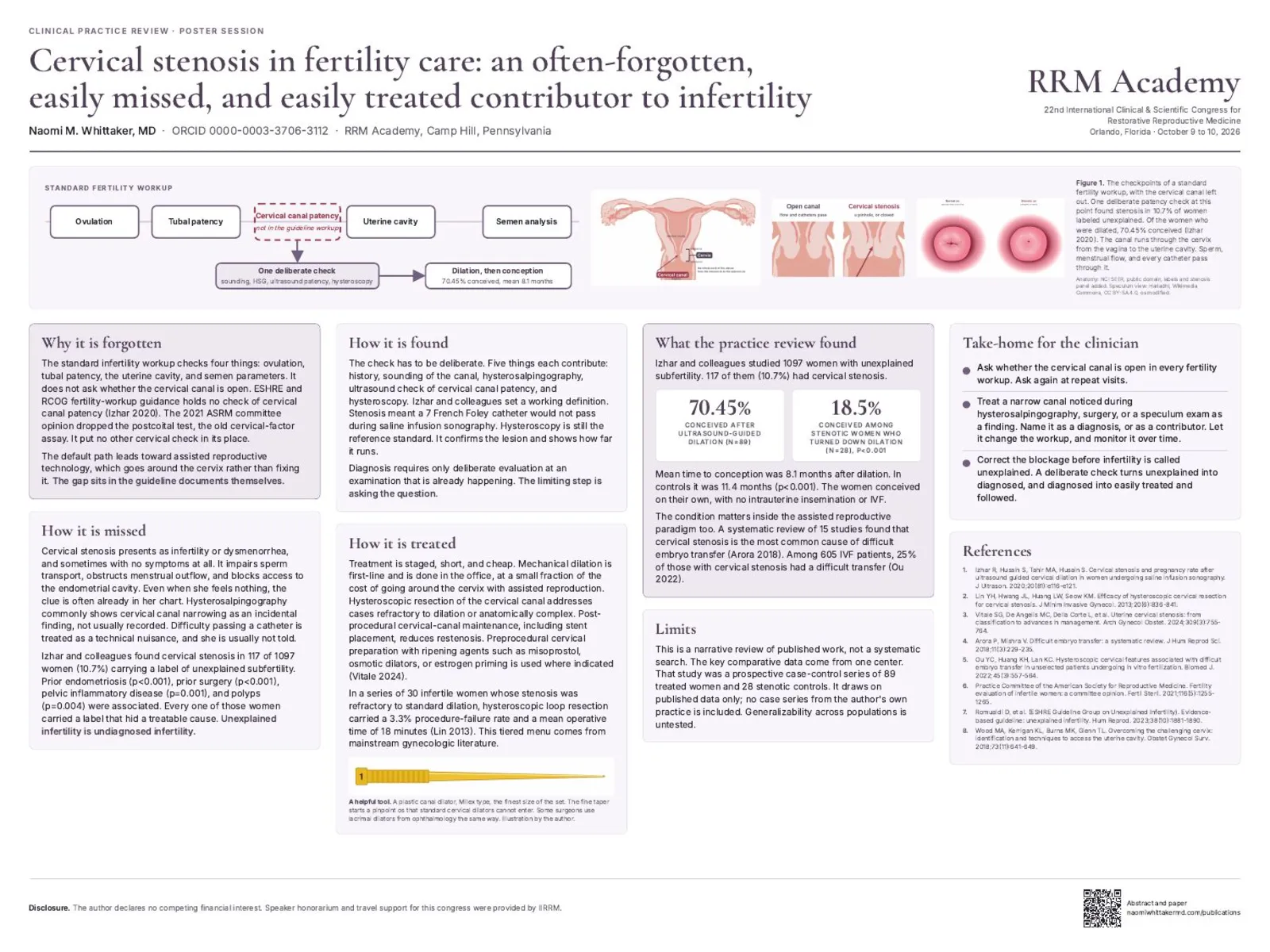
Cervical stenosis is a frequently overlooked contributor to infertility, dysmenorrhea, and recurrent pregnancy loss. It is easily missed on cursory examination yet usually obvious on deliberate evaluation, and once identified it is among the more straightforward conditions to treat in the restorative reproductive medicine (RRM) toolkit. The condition impairs sperm transport, menstrual outflow, and endometrial visualization. It can be congenital, post-surgical (cone biopsy, loop electrosurgical excision procedure, dilation and curettage, prior cervical conization), post-infectious, post-radiation, or idiopathic. In mainstream gynecologic practice the diagnosis is rarely pursued and the default management trajectory bypasses cervical correction entirely in favor of in vitro fertilization, which physically circumvents the cervix. The asymmetry between how easily cervical stenosis is treated and how often it is missed represents a recurring lost opportunity in mainstream fertility evaluation.
To review the diagnostic evaluation and restorative treatment options for cervical stenosis as practiced within RRM, and to highlight the diagnosis-versus-treatment asymmetry that makes this condition a high-leverage check in any fertility workup.
Narrative review of cervical stenosis literature filtered for restorative approaches: (1) diagnostic evaluation including history, sounding, hysterosalpingography, hysteroscopy, and ultrasonographic assessment of cervical canal patency; (2) interventional options including mechanical dilation under anesthesia, hysteroscopic correction, laser cervical reconstruction, post-procedural cervical-stent placement, and adjunct medical therapy (estrogen, mucolytics) where indicated; (3) reported outcomes from published RRM and natural-conception cohort series.
Cervical stenosis diagnosis requires only deliberate evaluation. Hysterosalpingography commonly identifies cervical-canal narrowing as an incidental finding. Hysteroscopic visualization is the reference standard for confirming the lesion and assessing extent. Treatment is staged and short: mechanical dilation as first-line, hysteroscopic correction or laser reconstruction for refractory or anatomically complex cases, with post-procedural cervical-canal maintenance to reduce restenosis. Outcomes data from published natural-conception cohorts demonstrate that restorative cervical correction restores fertility in a meaningful proportion of treated patients without recourse to assisted reproductive technology. Published series consistently report substantially higher diagnostic yield in RRM-aligned workups than in mainstream gynecologic practice, where the condition is frequently overlooked despite being readily detectable on the simplest deliberate examination.
Cervical stenosis is the kind of diagnosis the field cannot afford to miss: easily detected when looked for, easily treated once found, and consequential when overlooked. The restorative reproductive medicine clinician has a defined evaluation algorithm and a tiered intervention menu that mainstream practice often bypasses, primarily because the prevailing treatment paradigm proceeds directly to assisted reproductive technology rather than addressing the underlying anatomic obstruction. A deliberate cervical evaluation is a low-cost, high-yield component of any fertility workup regardless of paradigm.
More from RRM Academy
Search the RRM Academy Library for the studies behind this work, or ask RRM AI a clinical question.
