





Surgical technique, working model for feedback
Standardized Umbilical Reproducible Entry (SURE): a ten-step, single-instrument umbilical access technique for gynecologic laparoscopy
Poster, 22nd International Clinical and Scientific Congress for Restorative Reproductive Medicine, Orlando, Florida, 9 to 10 October 2026
Abstract
Injury at laparoscopy clusters at entry. The Cochrane review pooled 57 randomized trials, 9,865 participants, and 25 entry techniques, and found evidence insufficient to support one technique over another. Vascular and visceral events are too rare, and the trials too small, to separate. Failed entry is the one outcome where a comparison reached moderate-quality evidence. Closed entry commonly begins with the surgeon tenting skin, while the fascia stays untouched and its position unknown.
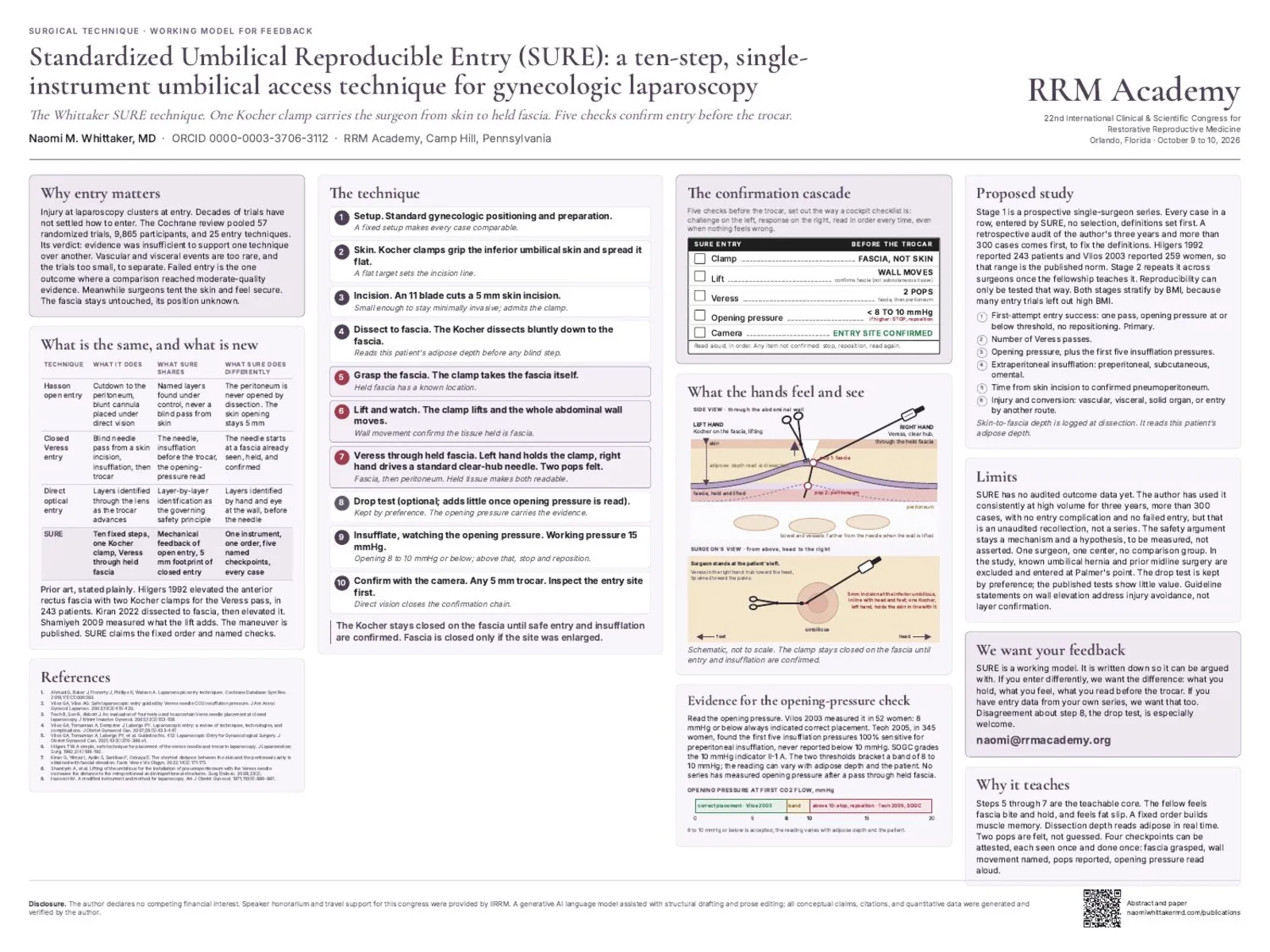
We describe a standardized ten-step umbilical entry performed with a single Kocher clamp, and set it against the published entry literature and prior art.
One Kocher clamp carries the surgeon from skin to held fascia. The clamp flattens the inferior umbilical skin, an 11 blade cuts a 5 mm incision, and the same clamp dissects bluntly to the fascia, grasps it, and lifts until the whole abdominal wall moves. The Veress needle then passes through fascia that has been seen and held. Insufflation follows, then a 5 mm trocar. Five checks confirm entry before the trocar: fascia and not skin in the clamp, wall movement on the lift, two pops, opening pressure at or below 10 mmHg, and the camera. The maneuver has prior art. Hilgers 1992 elevated the anterior rectus fascia with two Kocher clamps for the Veress pass in 243 patients. SURE claims the fixed order and the named checks. The author has used it consistently at high volume for three years, in more than 300 cases, with no entry complication. That is unaudited recollection, not data. A staged study is proposed: a retrospective audit of those cases, a prospective single-surgeon series entering every case in a row with first-attempt entry success as the primary endpoint, then a multi-surgeon series to test reproducibility.
SURE is a working model. No safety outcome is claimed, and none can be until the series is done: one surgeon, one center, no comparison group. It offers a fixed order and a set of checks that can be taught, attested, and counted. We bring it to surgeons who enter differently, and we want the difference.
More from RRM Academy
Search the RRM Academy Library for the studies behind this work, or ask RRM AI a clinical question.
