





Training architecture
A three-tier training architecture for restorative reproductive medicine: office diagnostics and tubal cannulation, S-MAP diagnostics, and surgical fellowship
Poster, 22nd International Clinical and Scientific Congress for Restorative Reproductive Medicine, Orlando, Florida, 9 to 10 October 2026
Abstract
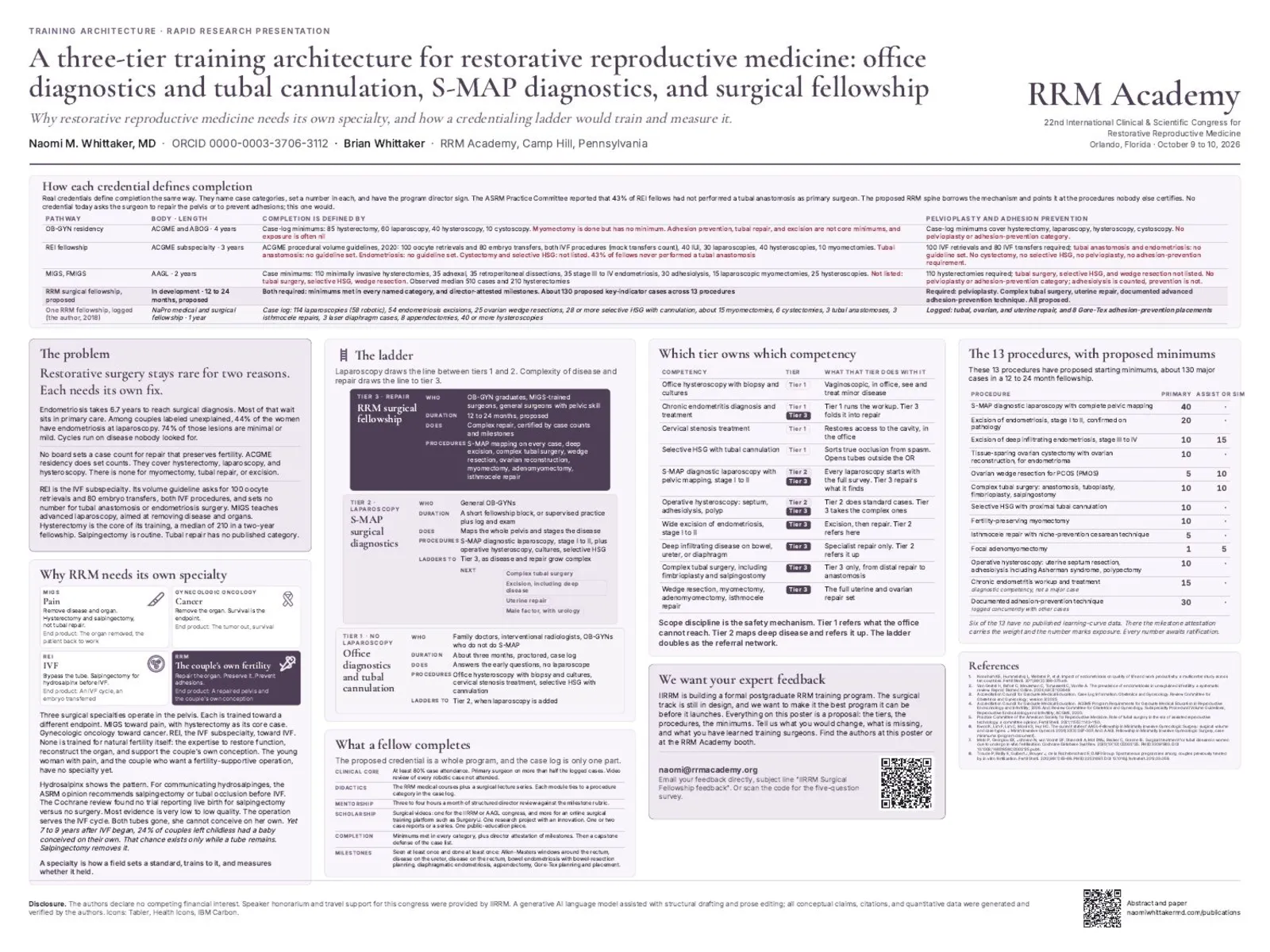
Restorative reproductive medicine works to find the cause, repair it, and keep the organ. No credential in the United States certifies that work. Endometriosis takes 6.7 years to reach surgical diagnosis, and 44% of women labeled unexplained have endometriosis at laparoscopy. Existing pathways certify other endpoints. The 2020 ACGME procedural volume guidelines for reproductive endocrinology and infertility ask for 100 oocyte retrievals and 80 embryo transfers, and set no guideline for tubal anastomosis or endometriosis surgery. AAGL fellowship minimums require 110 minimally invasive hysterectomies and list neither tubal surgery nor selective HSG. The ASRM Practice Committee reported that 43% of reproductive endocrinology fellows had not performed a tubal anastomosis as primary surgeon.
Conceptual analysis and program design. We read the published case-log minimums and program requirements of three existing pathways, listed the competencies restorative surgical care requires, and assigned each to the lowest tier that can safely own it. We then drafted a ladder with entry routes, procedure categories, proposed minimums, and completion rules.
Laparoscopy draws the line between tiers 1 and 2. Complexity of disease and repair draws the line to tier 3. Tier 1, office diagnostics and tubal cannulation, covers office hysteroscopy with biopsy and cultures, cervical stenosis treatment, and selective HSG with cannulation. It fits family physicians, interventional radiologists, and OB-GYNs who do not perform S-MAP. Tier 2, S-MAP surgical diagnostics, adds diagnostic laparoscopy with full pelvic mapping and operative hysteroscopy. Tier 3 is a proposed 12 to 24 month fellowship for complex repair: deep excision, complex tubal surgery, wedge resection, ovarian reconstruction, myomectomy, adenomyomectomy, and isthmocele repair. Tier 3 names 13 key-indicator procedures with proposed minimums, about 130 major cases, and requires both the minimums and director-attested milestones. Scope discipline is the safety mechanism, so the ladder doubles as a referral network.
Every tier, procedure, and number here is a proposal awaiting ratification. Six of the 13 have no published learning-curve data, so attestation carries the weight and the number marks exposure. The program is in development. We present the model to gather correction from clinicians who train surgeons. The poster carries a feedback survey.
More from RRM Academy
Search the RRM Academy Library for the studies behind this work, or ask RRM AI a clinical question.
