





Conceptual framework, working vocabulary for review
Classifying family planning methods and reproductive care by their action on the capacity to conceive
Poster, 22nd International Clinical and Scientific Congress for Restorative Reproductive Medicine, Orlando, Florida, 9 to 10 October 2026
Abstract
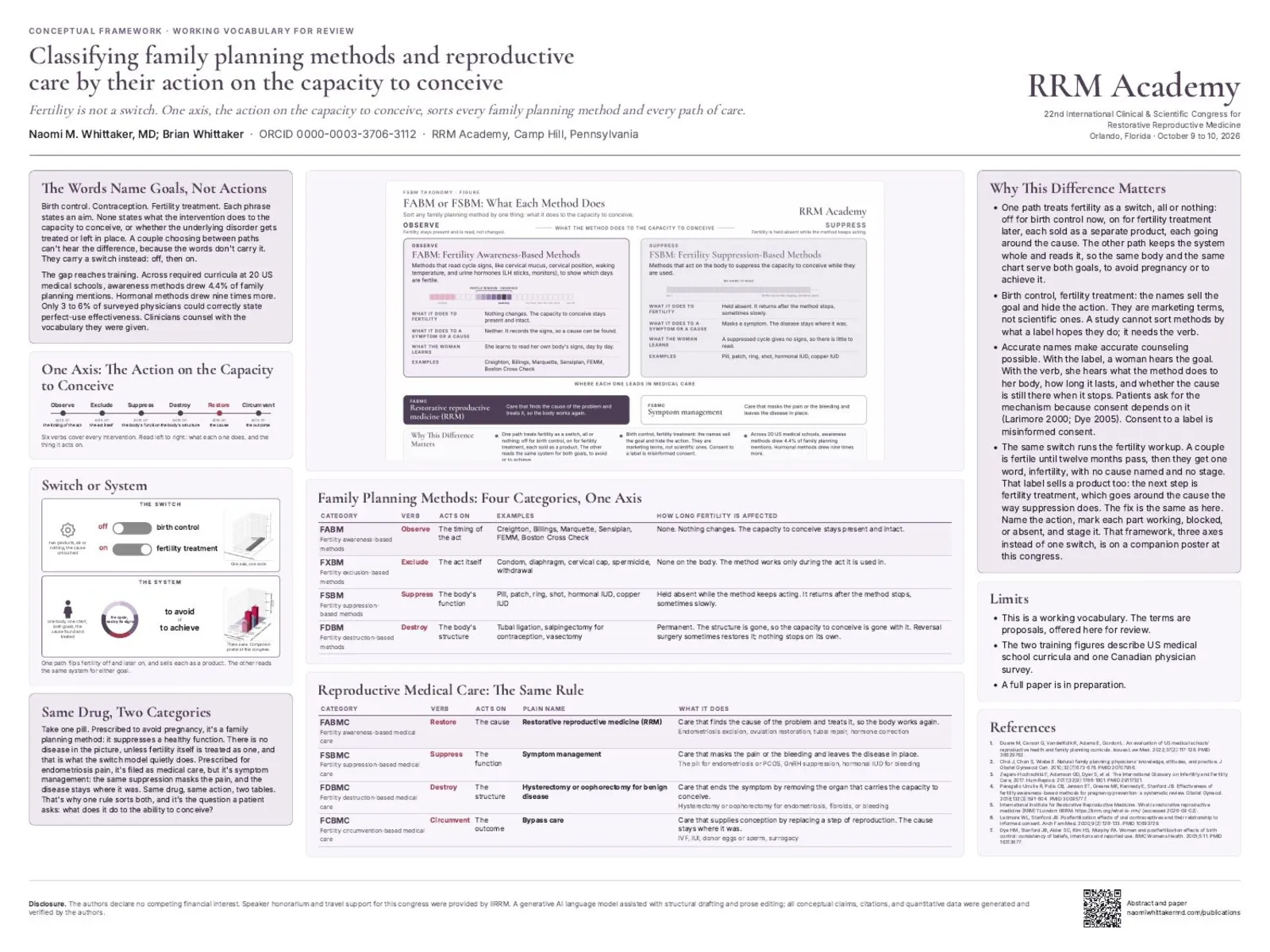
The terms that group reproductive interventions name goals: birth control, contraception, assisted reproduction, and fertility treatment each state an aim. None states what the intervention does to the capacity to conceive, or separates care that treats a disorder from care that leaves it in place. The gap reaches training. In required curricula at 20 US medical schools, fertility awareness-based methods (FABM) drew 4.4% of family planning method mentions; hormonal contraception nine times more. Only 3 to 6% of surveyed physicians could correctly state perfect-use effectiveness.
We mapped statements of mechanism, duration, and return of fertility across the pharmacology of hormonal methods and devices, the 2017 International Glossary on Infertility and Fertility Care, endometriosis guidelines, and FABM reviews. We placed each intervention by the object it acts on and by how long the capacity is absent. Candidate terms had to name a mechanism, be usable by the practitioners it names, and be exhaustive within a tier.
One axis classifies both tiers: the action on the capacity to conceive. Categories separate by the object acted on. Family planning methods sort by the timing of the act (FABM), the act itself (fertility exclusion-based methods, FXBM), the body's function (fertility suppression-based methods, FSBM), and the body's structure (fertility destruction-based methods, FDBM). Reproductive medical care sorts by the same rule: the cause (fertility awareness-based medical care, FABMC, known as restorative reproductive medicine), the function (fertility suppression-based medical care, FSBMC, suppressive care), the structure (fertility destruction-based medical care, FDBMC, organ-removing surgery for benign disease), and the outcome (fertility circumvention-based medical care, FCBMC, bypass care). Six verbs exhaust the axis: observe, exclude, suppress, destroy, restore, circumvent. Every coined term carries a plain synonym; every suppressive entry a duration. The same hormonal agent is a suppression-based method when prescribed to avoid pregnancy and suppressive care when prescribed for endometriosis. Three of the four care categories leave the cause in place.
Action, object, and duration classify every method and pathway of care. Counseling can state what an intervention does, for how long, and what happens to the underlying condition. A full paper is in preparation.
More from RRM Academy
Search the RRM Academy Library for the studies behind this work, or ask RRM AI a clinical question.
