Plant vs. Animal Vitamin A: Why Beta-Carotene Isn't Retinol
Preformed vitamin A from animal foods is absorbed well. Beta-carotene from plants has to be converted first, and the official factor is 12 to 1. Real foods, rea...

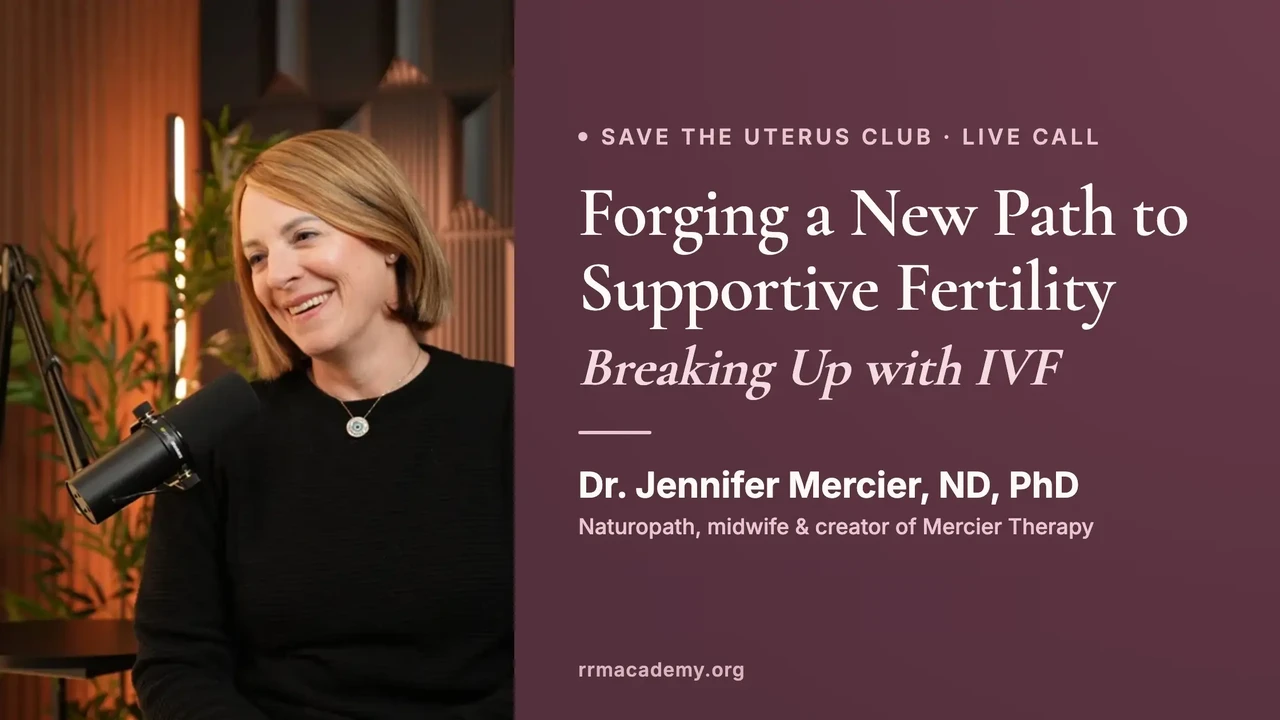 Breaking Up with IVF Free for membersMidwife and former front-line IVF clinician Dr. Jennifer Mercier joins Dr. Naomi Whittaker for a candid Save the Uterus Club conversation.
 Masterclass in Endometriosis & Surgery 9 sectionsComprehensive guide for patients preparing for endometriosis surgery.
 Hormones Through the Lifespan Free for membersA comprehensive overview of hormonal health across a woman's life, menstrual cycles, common conditions, and the transition to menopause, presented by Dr. Ana Garcia, OB/GYN.

Vitamin A in pregnancy carries a U-shaped risk. Too much preformed vitamin A early in pregnancy is linked to birth defects. Too little causes birth defects too.
Here's the evidence on both sides, and how strong each piece is.
At very high intakes, it can. Drugs chemically similar to vitamin A, called synthetic retinoids, cause birth defects in people [1]. The acne drug isotretinoin is one of them. In animals, natural forms of vitamin A cause birth defects too [1].
The study that set today's caution about vitamin A in pregnancy came out in 1995. It followed 22,748 pregnant women and recorded their intake in the first trimester [1]. It looked hardest at cranial neural crest defects [1]. These cells help build the face and head.
Some women took in high amounts of preformed vitamin A from food and supplements together [1]. Their babies had 3.5 times the rate of those defects seen at the low end [1]. From supplements alone, the highest intake carried 4.8 times the rate [1]. For women on high-dose supplements, the authors estimated about 1 in 57 babies had a defect from the supplement [1]. Critics later questioned how the study classified the birth defects [16].
The risk came from preformed vitamin A, not beta-carotene [1]. A later study found the same pattern for one heart defect. It compared 126 babies with heart outflow defects to 679 babies without birth defects [2]. High-dose supplemental retinol carried about 9 times the odds of transposition of the great arteries [2]. Retinol from food wasn't linked to either type of defect [2]. In that defect, the heart's two main arteries are switched.
Other studies didn't find the 1995 link. A 1997 case-control study compared 935 mothers of babies with birth defects to 573 mothers of babies without them [14]. The 1995 study had flagged a certain level of intake. Mothers of affected babies were no more likely to have gone above it with vitamin A from supplements and fortified cereal [14]. The same held for cranial neural crest defects [14]. The authors concluded that if vitamin A does cause birth defects, it seems to take a dose well above what most women take in early pregnancy [14].
A 1999 study enrolled women who had taken high doses of vitamin A in the first 9 weeks of pregnancy. It then followed them forward [15]. Among 311 babies checked, it found no evidence of a higher rate of major birth defects than in comparison groups [15]. It was a small study, too small to rule out a modest rise in risk [15].
So the human studies disagree about the amounts the 1995 study flagged. A 2000 review noted that too few women in the case-control studies took in high amounts. So the results didn't reach statistical significance, the bar that shows a result is unlikely to be chance [16]. No one disputes the risk of the retinoid drugs. The federal upper limit still stands, and it covers only preformed vitamin A [3]. It doesn't apply to beta-carotene.
Very high intakes are uncommon. In a national survey, fewer than 0.5% of pregnant women went over the upper limit for retinol [4]. A count of 214 US prenatal vitamins found none above it [5].
In animals, the evidence is strong and consistent. It goes back to 1933, when sows fed a diet lacking vitamin A gave birth to piglets without eyes [6].
Rat studies in the 1940s and 1950s mapped what researchers called the vitamin A deficiency syndrome [6]. In one model, 49% of fetuses had eye defects [6]. Kidney defects appeared in 38%, and holes in the diaphragm in 31% [6]. A later model produced these defects in up to 100% of fetuses [6]. Restoring retinol prevented them [6].
Rare human genetic disorders make the same point. Retinol needs a receptor to enter cells, called STRA6. Children with two broken copies of that gene can have missing eyes and heart defects [7]. Some have a hole in the diaphragm and underdeveloped lungs [7].
A second gene makes RBP4, the protein that carries retinol in the blood. Mutations cause eye malformations, up to missing eyes on both sides [8]. Defects were more common when the mother passed the gene on [8]. The faulty protein also blocks delivery across the placenta [8]. The paper's first line reads: "Gestational vitamin A (retinol) deficiency poses a risk for ocular birth defects" [8].
In ordinary human diets, the signal is suggestive and small, and it centers on one defect. Congenital diaphragmatic hernia is a hole in the muscle between the chest and the belly. Organs can push up into the chest and crowd the lungs.
Two small studies measured newborns' blood. In the first, babies with the defect had retinol levels about 50% lower than healthy babies [9]. In the second, newborns with low retinol had about 11 times the odds of the defect [10]. Mothers' blood levels weren't lower in either study [9][10].
Diet studies point the same way. In one, normal-weight mothers with low vitamin A intake had about 7 times the odds of the defect [11]. The link didn't hold in underweight or overweight mothers [11]. A large US study had 377 affected babies [12]. Among mothers not taking supplements, a lower retinol intake was linked to the defect. So were lower intakes of several other nutrients [12]. A Japanese study of 89,658 births leaned the same way. Overall, though, its result didn't reach statistical significance [13].
These studies are small, and their margins of error are wide. They add up to a repeated signal. They don't prove cause.
Heart defects are a different story. One study found no link between dietary retinol or carotenoids and heart outflow defects [2]. We know of no convincing human study tying low maternal intake to heart defects. We also found no study showing US birth defect rates rising as vitamin A in the food supply fell.
Look at the pieces together. Many pregnant women in the US already fell short on vitamin A from food alone [4]. The food supply has lost sources since then. No federal rule we found requires prenatal vitamins to carry it. Plant vitamin A converts poorly, especially in people with common gene variants.
And the biology is clear in animals and in human genetic disorders: vitamin A is needed to build a baby. When the inputs shrink and the stakes are that high, it could be a recipe for disaster.
More isn't automatically better. The high side has its own birth defects, and the form matters.
Both ends of the curve are real, and the form matters. Preformed vitamin A carries the high-side risk. Beta-carotene hasn't been tied to it, but it converts poorly.
Bring your diet, your prenatal label and your questions to your clinician. Bring your partner, too. A restorative evaluation looks at both of you and asks why, before it treats.
This is part of a series on vitamin A:
Pam Schoenfeld, MS, RD, LDN, a registered dietitian and co-author of this post, gave the Save the Uterus Club members talk "Vitamin A: Critical for Female Fertility." Pam shares her approach and her references.
Join the Save the Uterus Club, RRM Academy's community, for the full session library.
Dr. Naomi Whittaker is a board-certified OBGYN. Pam Schoenfeld is a registered dietitian who has written about vitamin A for a decade. This article is educational and is not medical advice or a substitute for care from your own clinician.
Preformed vitamin A from animal foods is absorbed well. Beta-carotene from plants has to be converted first, and the official factor is 12 to 1. Real foods, rea...

In a count of 214 US prenatal vitamins, about a quarter listed no vitamin A. In a 2022 review of 188, only 35% contained the ready-made form. There's no federal...

More than a quarter of pregnant women in a national US survey fell short on vitamin A from food alone. Since then, organ meats left the table, milk drinking fel...