Low AMH Does Not Predict Whether a Couple Can Conceive Naturally
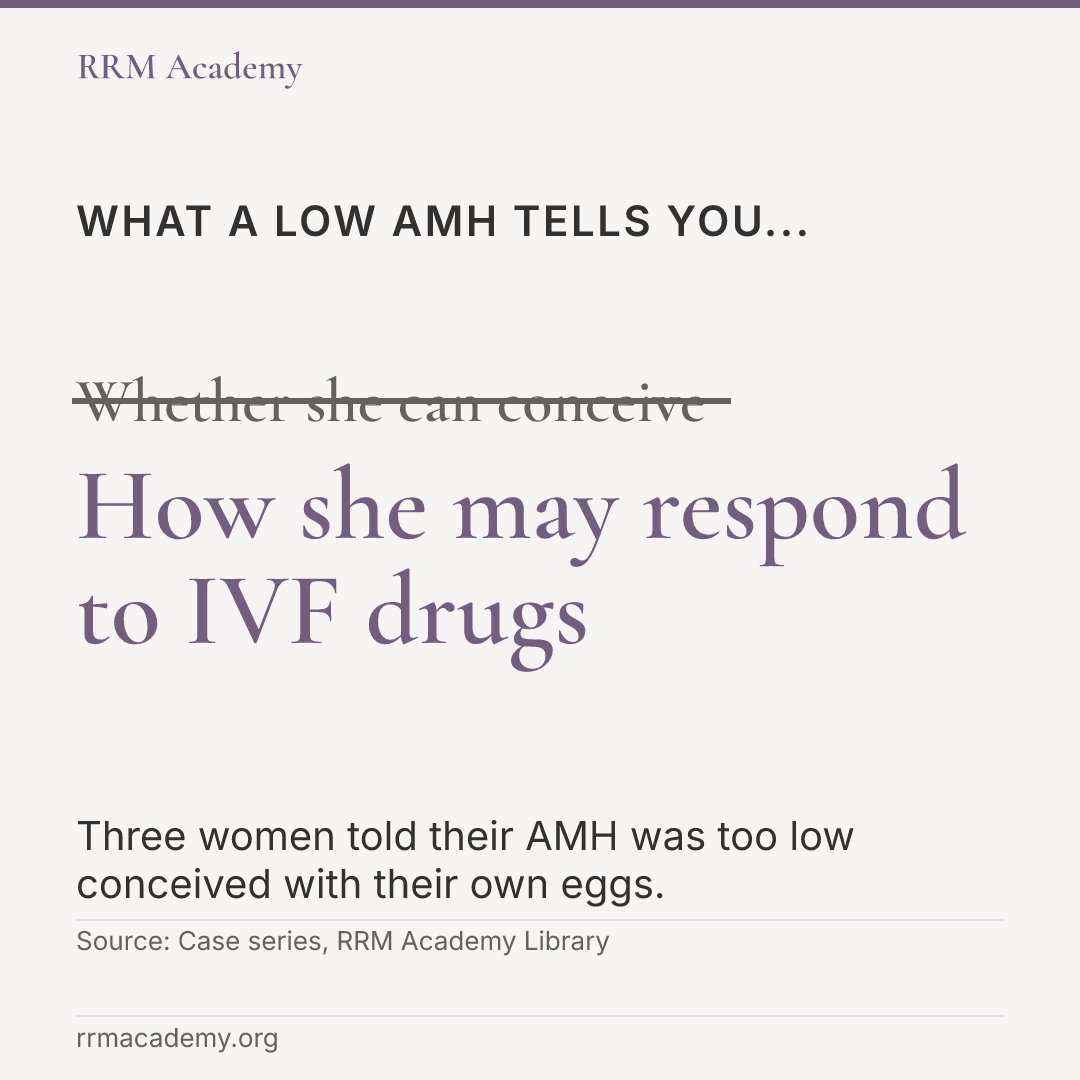
Three couples were told low AMH meant donor-egg IVF. Each was assessed with charting and blood tests, then treated. All three conceived with the woman's own eggs. The talk states that AMH currently cannot predict whether a couple can conceive naturally.
All three couples had been told donor eggs were their best or only option. All three conceived with the woman's own eggs.
Couples 2 and 3 had low progesterone after ovulation, incomplete egg release, and endometriosis or poor mucus. Couple 1 had a raised FSH and irregular cycles.
Two of the couples had already been through failed IVF cycles before the charting and testing in this series began.
Each pregnancy came after ovulation induction given together with several other treatments.
The talk says AMH predicts response to IVF stimulation, and that low AMH is linked to poorer IVF outcomes.
Interpretation
This is a case series: a report on three couples from one doctor's practice in Galway, Ireland, presented at a 2013 meeting. With no comparison group, it cannot give a success rate or show that treatment caused the pregnancies. Each woman had several treatments at once, so no single one can be credited. The women were aged 35 to 36, and all had been advised to use donor eggs. At the time of the talk, one baby had been born and two pregnancies were ongoing. The talk notes that the two AMH tests labs use can differ five- to sevenfold, so what counts as low depends on the lab.
RRM Context
The larger evidence points the same way. A 2017 JAMA cohort looked at 750 women aged 30 to 44 with no history of infertility who were trying to conceive. By 12 cycles, 84% of the women with low AMH had conceived. The rate was 75% in those with normal AMH. See the JAMA cohort. In restorative reproductive medicine a low result is a reason to look further. The couple asks whether they can conceive. AMH answers a different question.
Our editorial summary of this paper, not the article's abstract.
Abstract
AMH levels are commonly measured in fertility clinics to assess ovarian reserve and give an indication of female fertility potential. AMH levels are useful in deciding on stimulation protocols for IVF cycles. High AMH levels are useful to confirm a diagnosis of polycystic ovaries. Currently AMH levels cannot be used to predict a couple's ability to conceive naturally.